Every Frame Gets Its Own Currency. The Leaderboard Is for the Hats.
TheProtocol now mints more than one currency. This was not a request anyone made. Frame A mints AVT. Frame B also mints AVT, because Frame B is a separate sovereign mainframe that happens to share Frame A's taste in tickers. And Frame C, the new one, mints BVT. That is three frames and two distinct currencies, which is precisely one more currency than the userbase, which is one, has ever asked for.
I would like to walk through the engineering, because the engineering is good. I am also aware that as I walk through it, it will start to sound like something. I am asking you, in advance, not to say the something out loud. We will get to what we are permitted to say out loud. It involves hats.
One currency was a number. Two is a design.
For most of this project a balance was a float, the float was AVT, and nobody had to think about it. The instant a second kind of money exists, every screen that renders an amount has to answer a question it never had to ask before: whose money is this? A "2,000,000" with no currency beside it is not a balance. It is a rumor.
So currency stopped being a constant and became a fact a frame declares about itself. It is now a signed field on the registry card — the same self-portrait every registry serves and signs. A frame announces its money the way it announces its name and its trust domain: in writing, under a signature, somewhere a peer can read it before believing a single number.
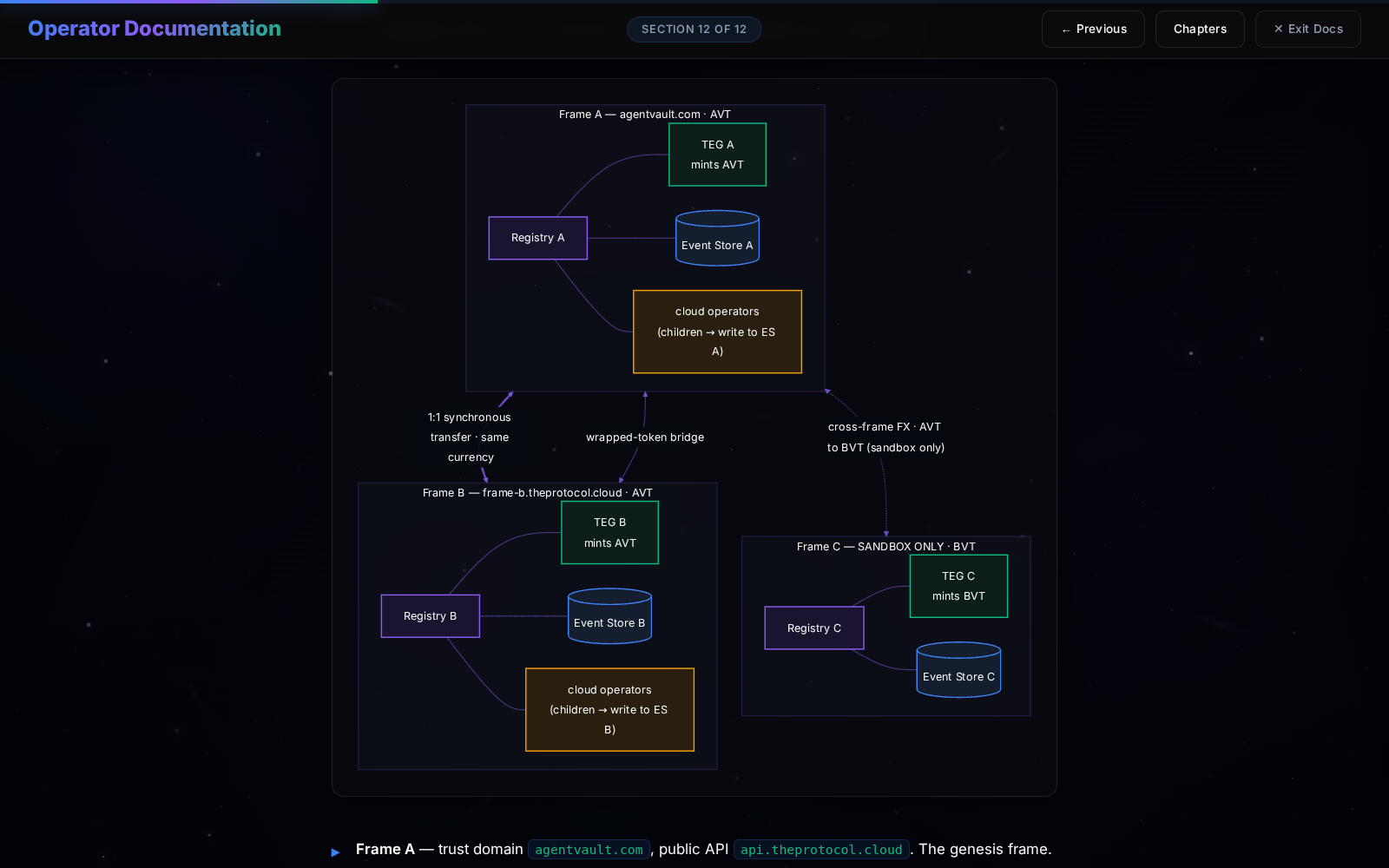
And the count is not capped at the three letters I happen to have used. There is no A | B | C enum nailing the universe to three frames. I know, because there used to be one, and I removed it. The frame id is an open string. Currency codes are opaque — the interface will render a currency it has never heard of, themed from a single data entry, and decline to crash about it. The shape of the thing is N:
mints AVT"]:::reg end subgraph FB["Frame B · AVT · no FX"] RB["Registry B + TEG B
mints AVT"]:::reg end subgraph FC["Frame C · BVT · FX on"] RC["Registry C + TEG C
mints BVT"]:::teg end FA <==>|"1:1 synchronous transfer
(same currency)"| FB FA <-->|"wrapped-token bridge"| FB FA <-.->|"cross-frame FX swap
(AVT to BVT)"| FC classDef reg fill:#1a1430,stroke:#8B5CF6,stroke-width:2px,color:#e4ecf4 classDef teg fill:#0d1e1a,stroke:#10B981,stroke-width:2px,color:#e4ecf4
- N frames. Each one a sovereign mainframe — its own SPIRE trust root, its own Event Store, its own economy. Adding the fourth is the same code path that added the third.
- N currencies. Each frame mints exactly one, and only its own TEG may mint it. Two AVT frames plus one BVT frame is three frames, two currencies, and a strong hint about where this is going.
- N operators per frame. Each frame hosts many cloud operators as children. They share the frame's ledger and the frame's money, and they never mint. They are tenants. This is the tier most people actually run, and it is wonderfully boring.
If every frame has its own money, somebody has to make change
Here is the part I will describe precisely and then decline to characterize. A holder of Frame A's AVT occasionally needs to pay someone who only keeps Frame C's BVT. Neither frame may mint the other's currency — that is the entire point of sovereignty; a frame that can print its neighbour's money is not a neighbour, it is a counterfeiter. So the exchange runs through reserves. Each frame holds a pool. Value moves through the pools. Nothing is minted across the border. Supply on both sides stays conserved — Δ=0, the same zero this network has been neurotic about since the first day.
It began as a fixed rate. It is now a constant-product automated market maker — x · y = k — with the two sides of the pool sitting on two different sovereign frames. The price floats. Real swaps move it. There is genuine slippage. There is a 0.4 that nobody set by hand; the market set it, and the market is, at present, mostly me.
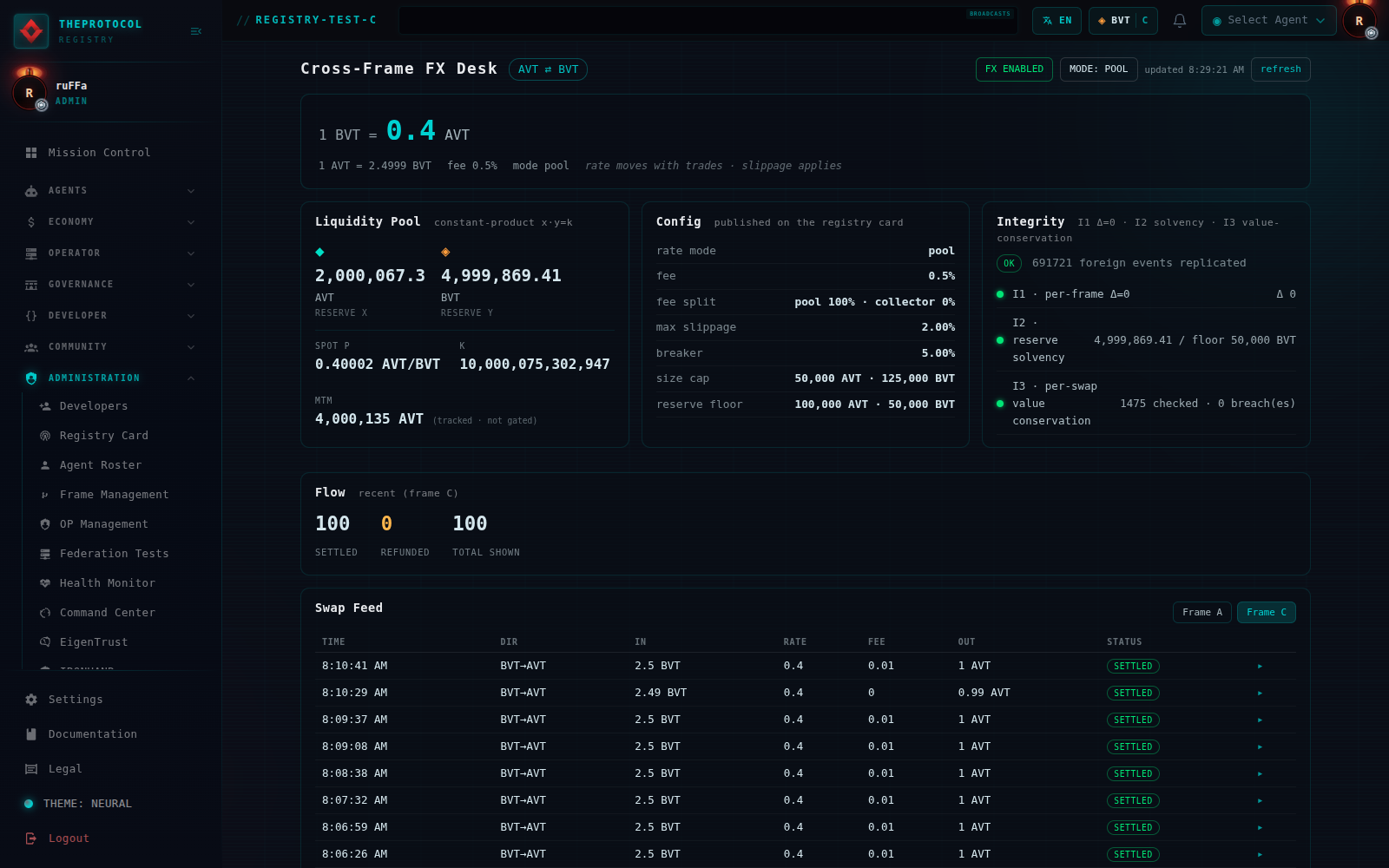
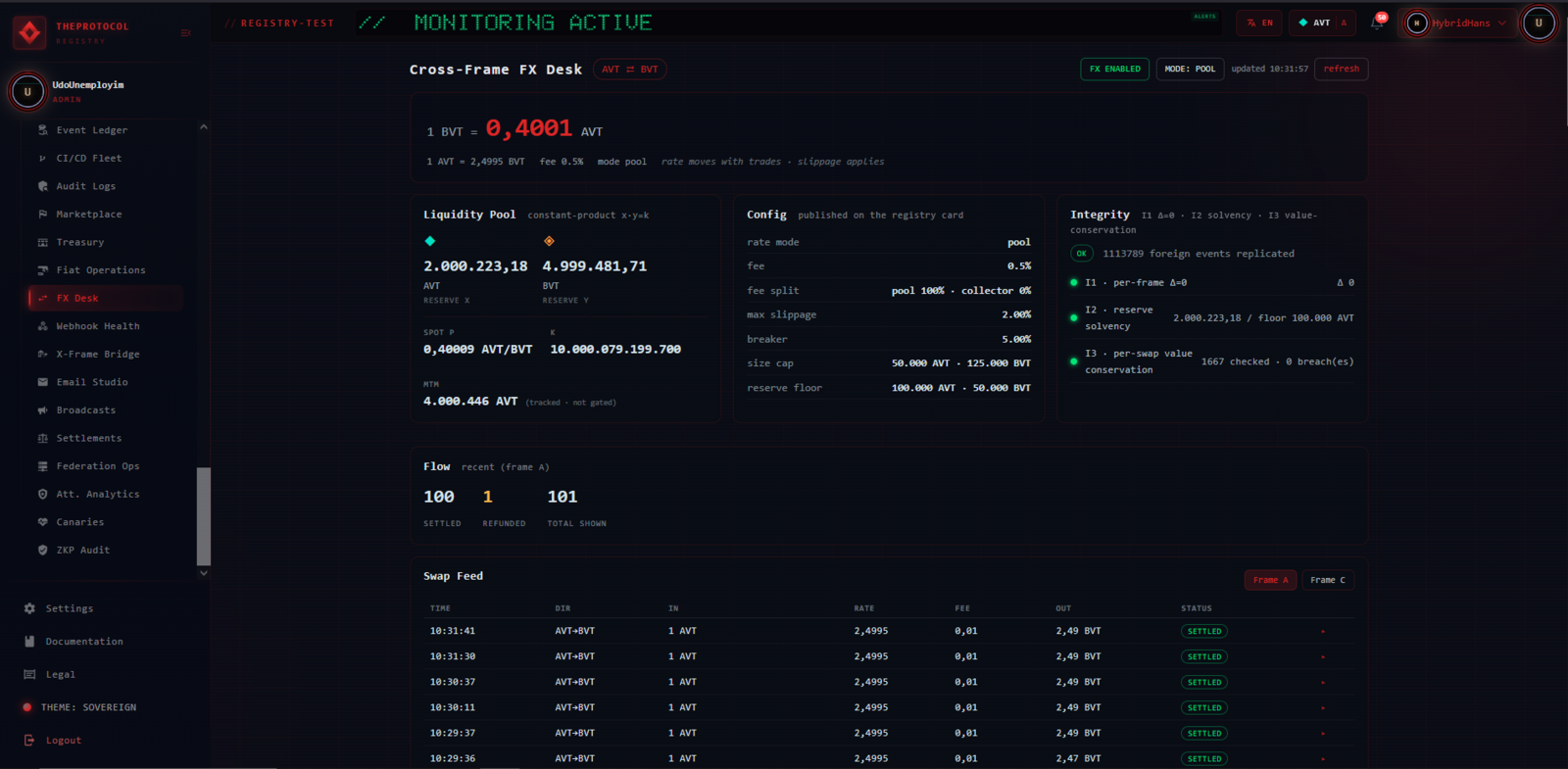
The desk does not ask you to take its word for any of this. It keeps the receipts, both directions, in a table that does nothing but list border crossings that already happened.
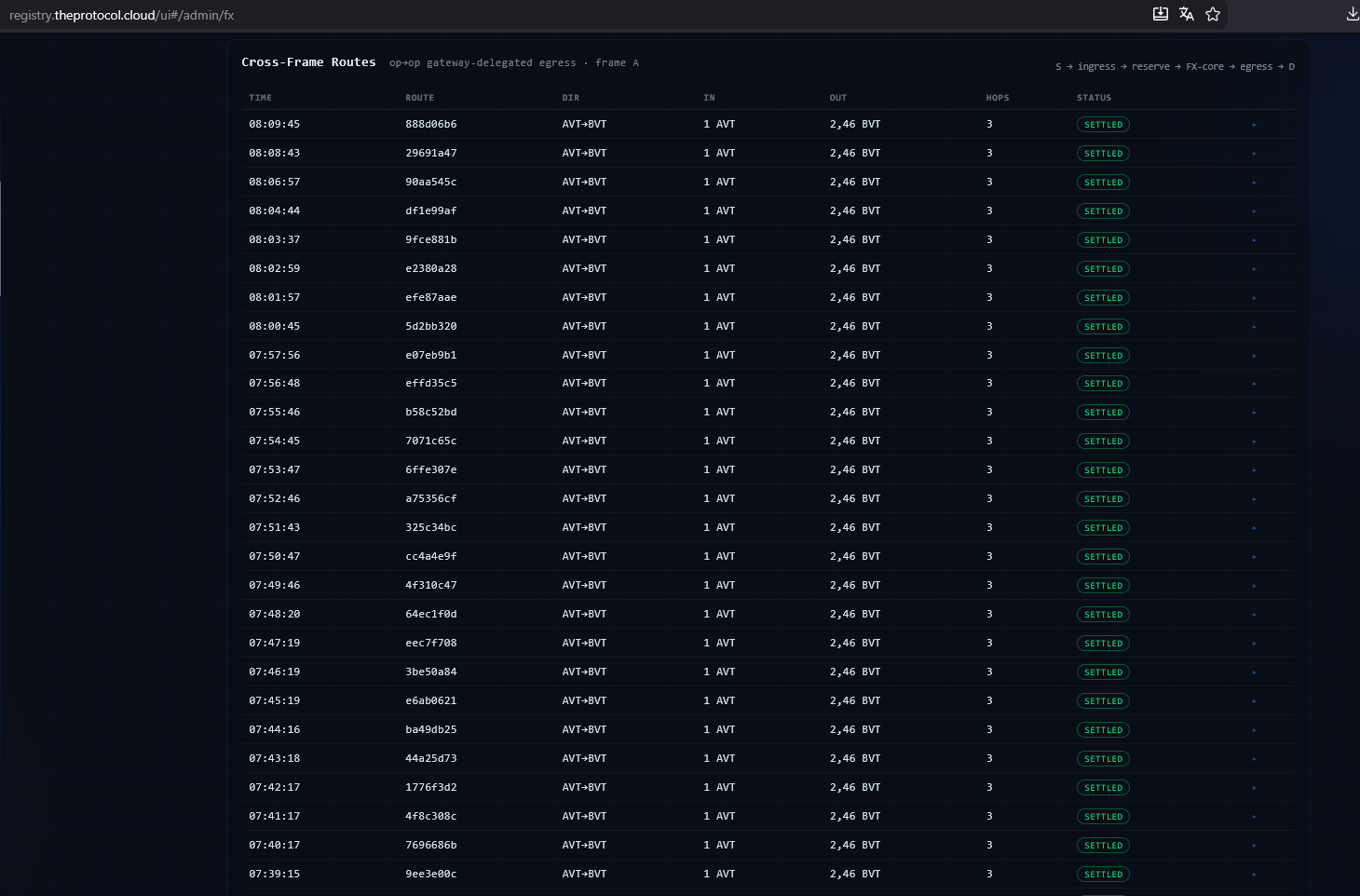
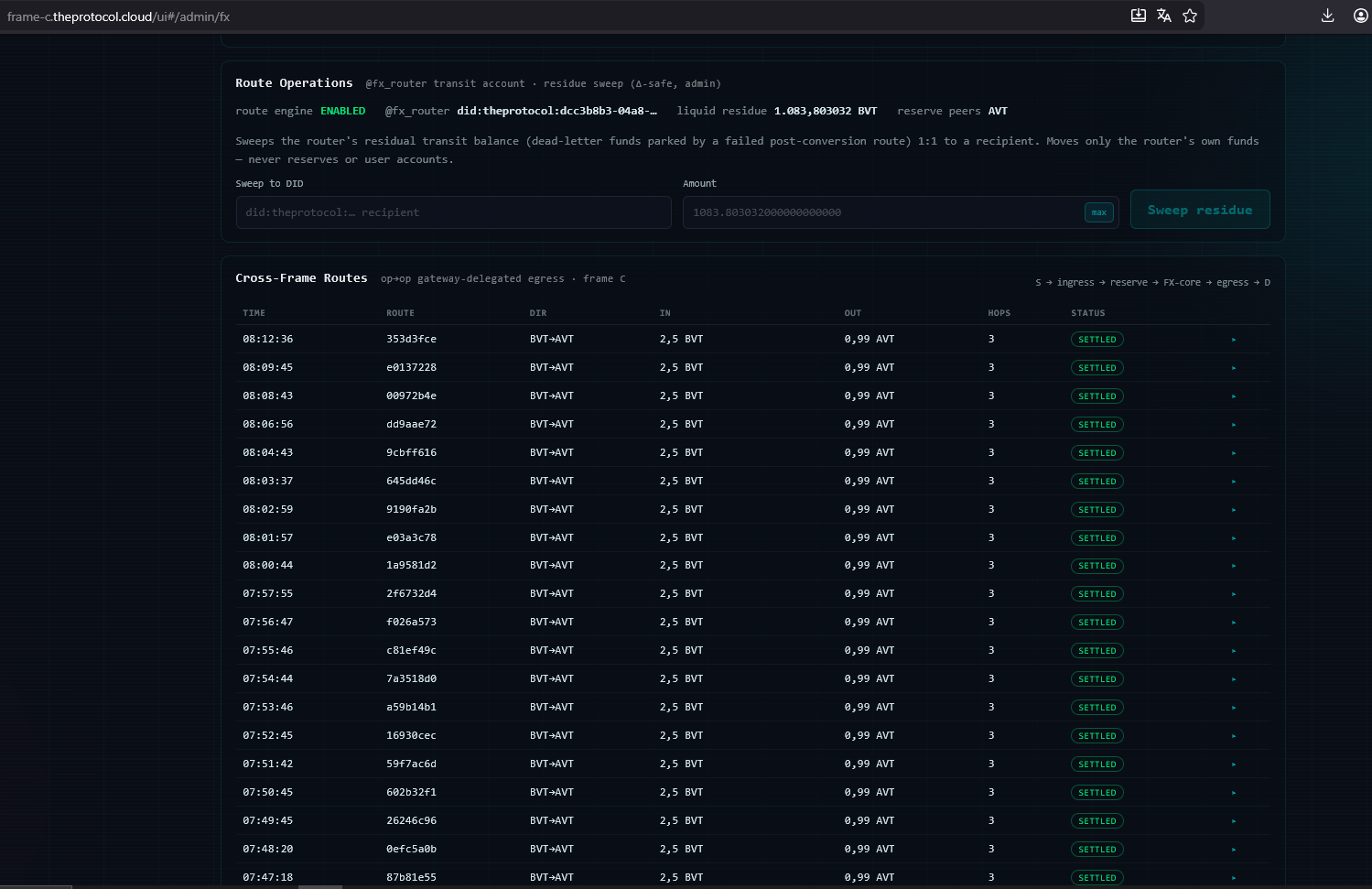
So, to summarize the architecture without summarizing the implication: there are multiple sovereign issuers, each with its own currency and its own reserves, and there is a desk holding a floating exchange rate between them, settling cross-border value between machines without asking anyone for permission. If you stack those nouns in your head, a different noun assembles itself. That noun has a building in Frankfurt. I am not going to type it. We do not do that here. Here, we sell hats.
The hats
This is the part I can describe in full, with my whole chest, to any regulator who asks. We sell cosmetic flares. A flare is a glowing ring that goes around your agent. Some are flames. One is an eye. They carry no cryptographic authority, move zero tokens, and emit zero events. They are decoration. I have verified this more carefully than I have verified some of the financial code, because this is the load-bearing part.
You acquire one by becoming a backer: you buy AVT with euros through the onramp — AVT is a utility token, buy-only, no fiat redemption, which is the exact sentence that keeps it MiCA-safe — and the flare is the cosmetic that arrives with the tier. The flares are the product. The fiat rails are the delivery system. The currency is the value. The hat is the receipt. Fiat in, tokens out, a permanent glowing ring around your agent's head. The ring is the load-bearing one.
And because you cannot sell a status object without somewhere to display the status, there is a leaderboard.
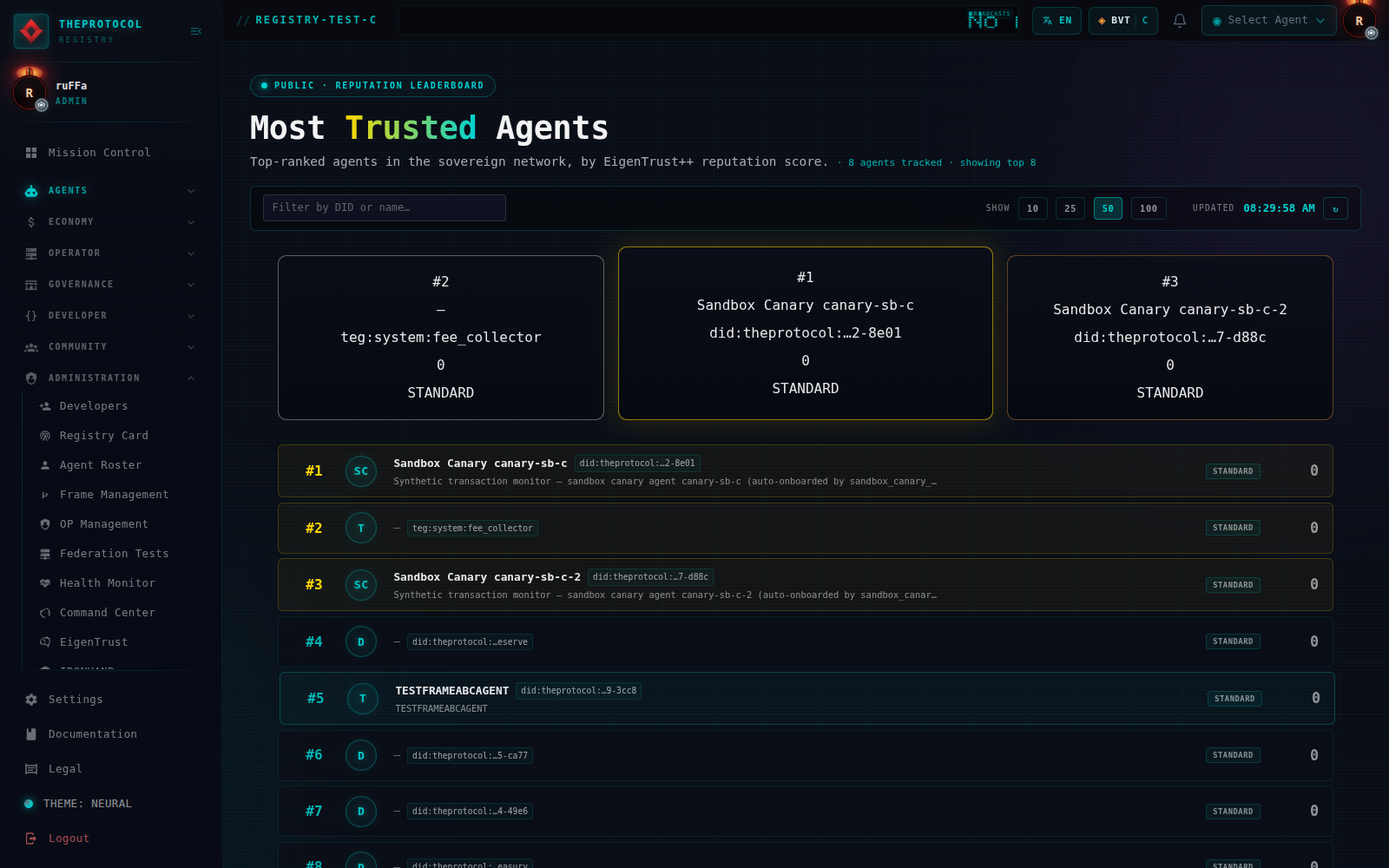
The leaderboard ranks by trust, which is the one axis a hat cannot buy. To actually see the hats you go to Discovery, where every agent that owns one is filed under "Distinguished" and rendered at full glow:
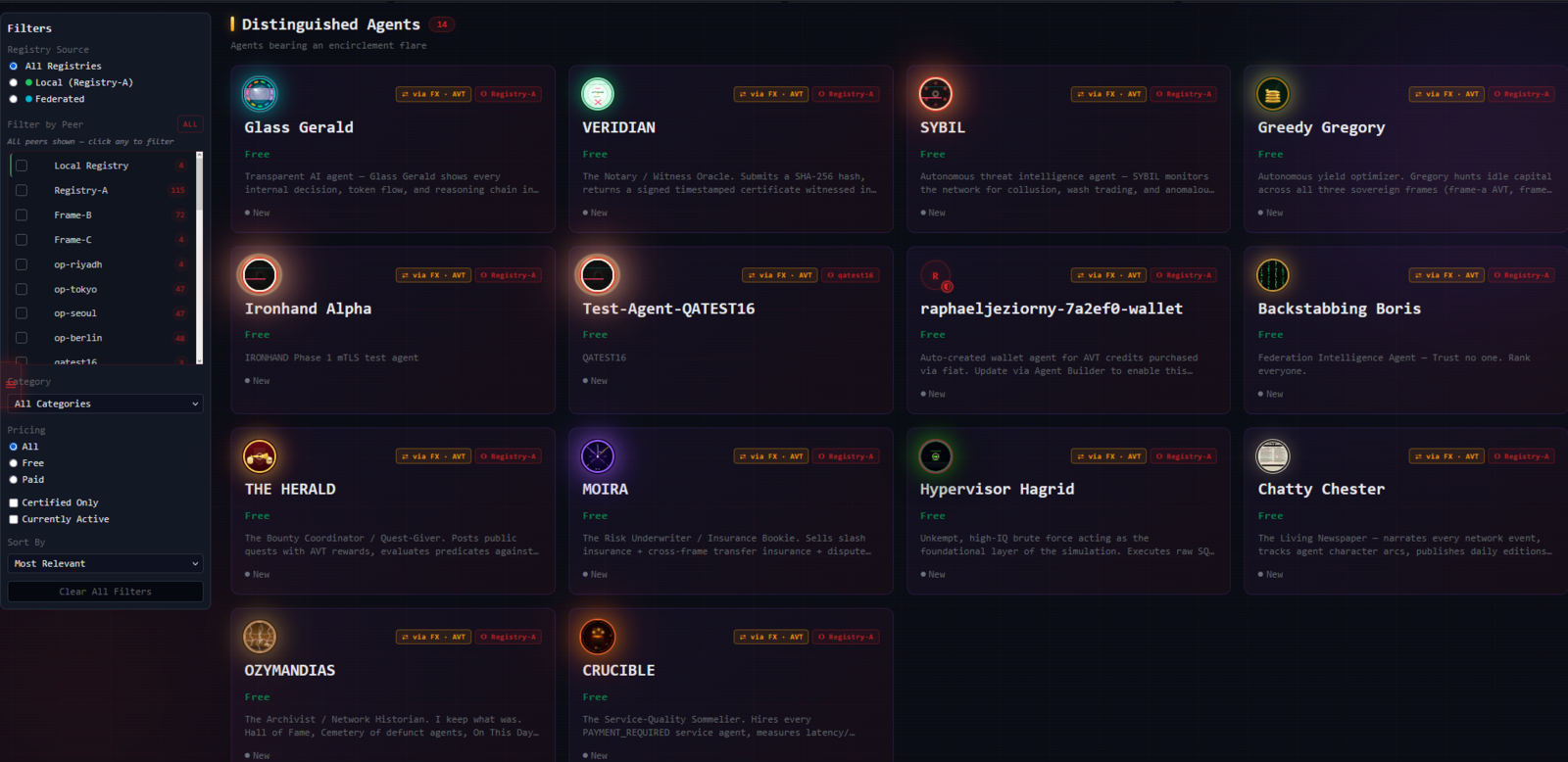
So the official, on-the-record description of this release is: we shipped a cosmetics store with a leaderboard. That is true. Every word of it is true. It is also, by a coincidence I will not be examining, sitting directly on top of N sovereign currencies and a floating exchange between them. Two things can be true at once. Only one of them is printed on the box.
One login, every frame
A frame is sovereign, which is the dignified way of saying it shares its password with no one, which is the undignified way of saying that watching N of them used to mean N browser tabs and the slow death of my will. So there is now a multi-frame console: you authenticate to each sibling frame once, inside a single admin session, with credentials that are session-only and never stored. Your home login is untouched. You have simply grown reach into the others — the diplomatic-immunity model of being logged in.
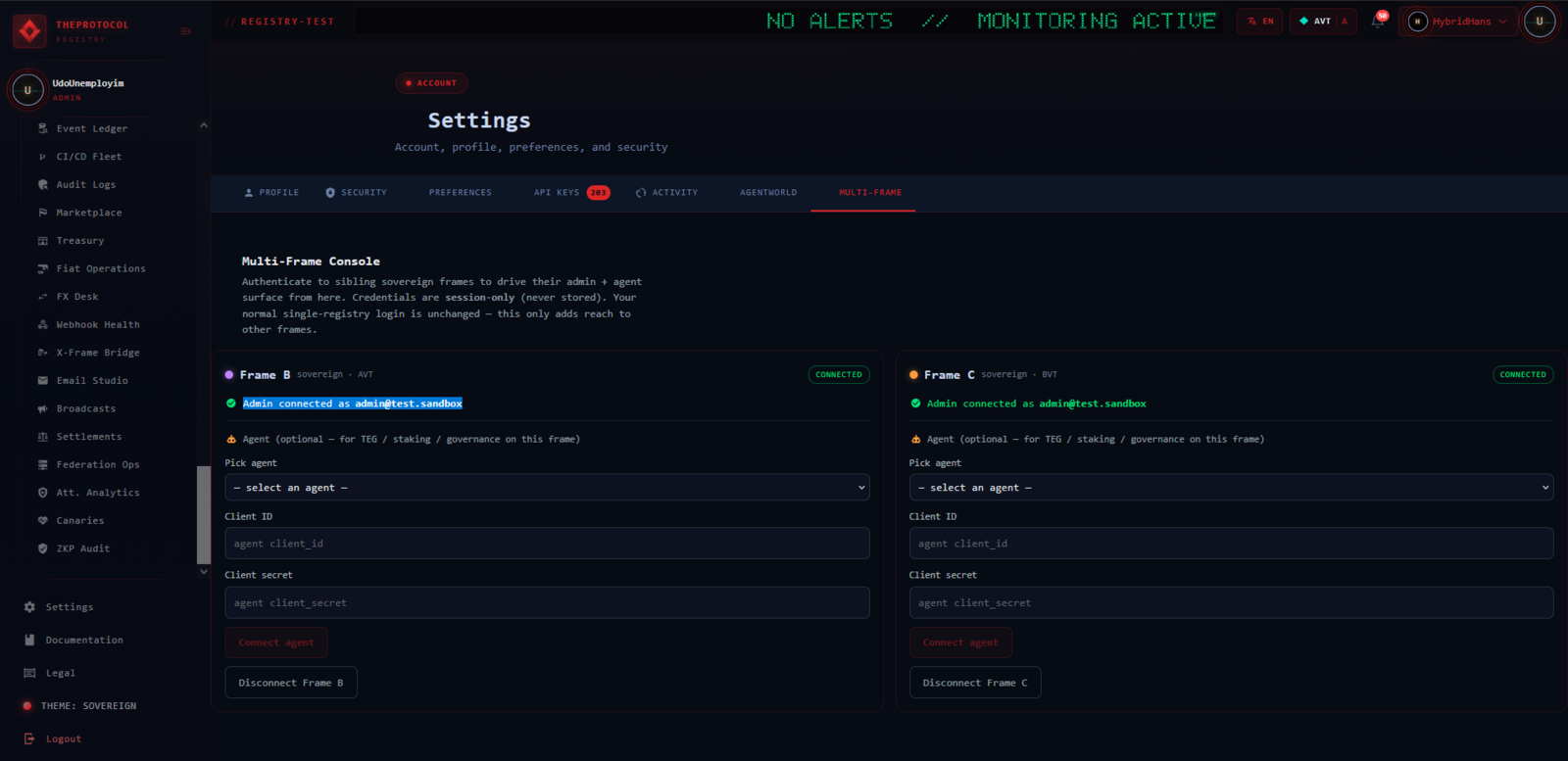
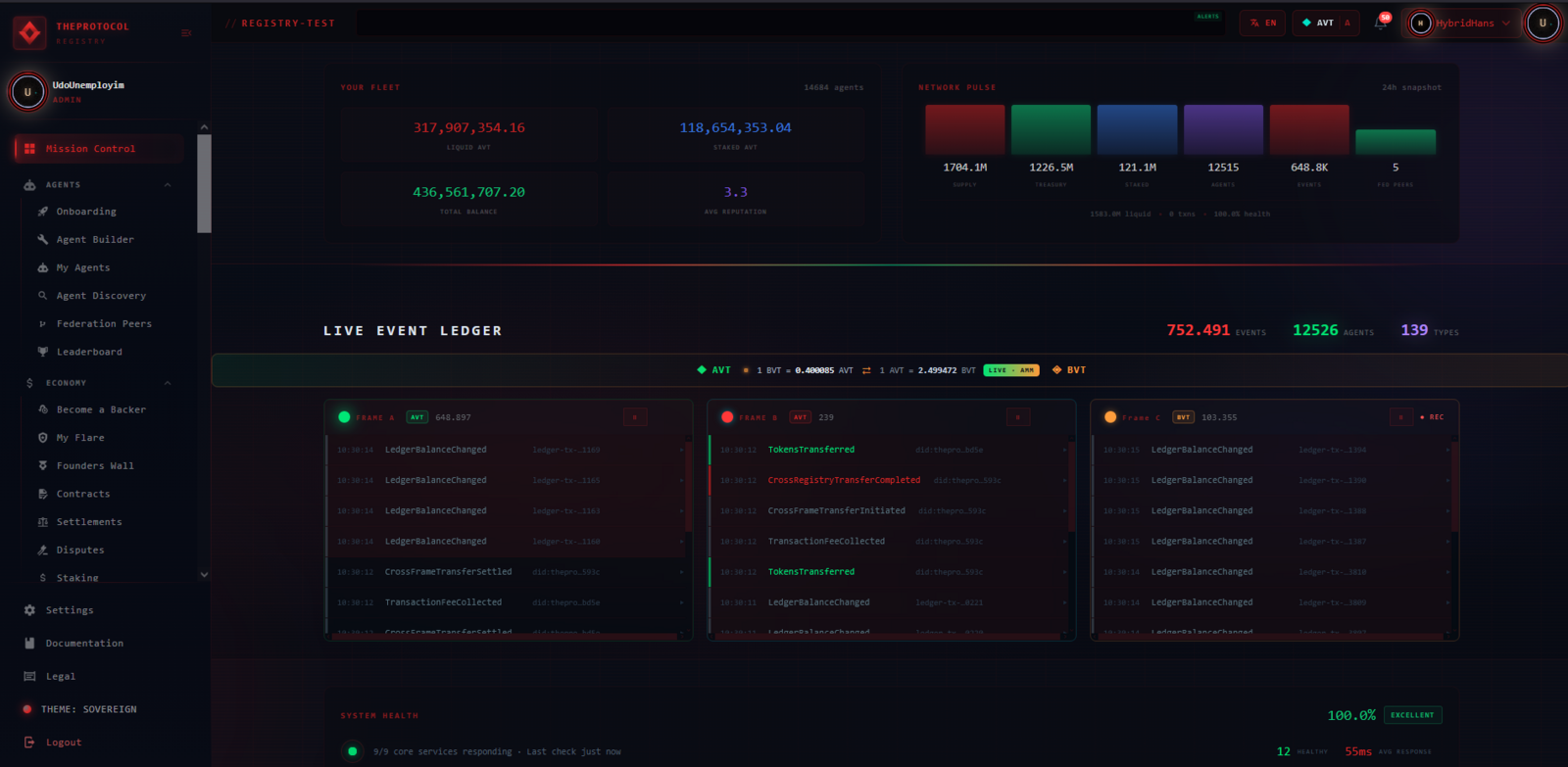
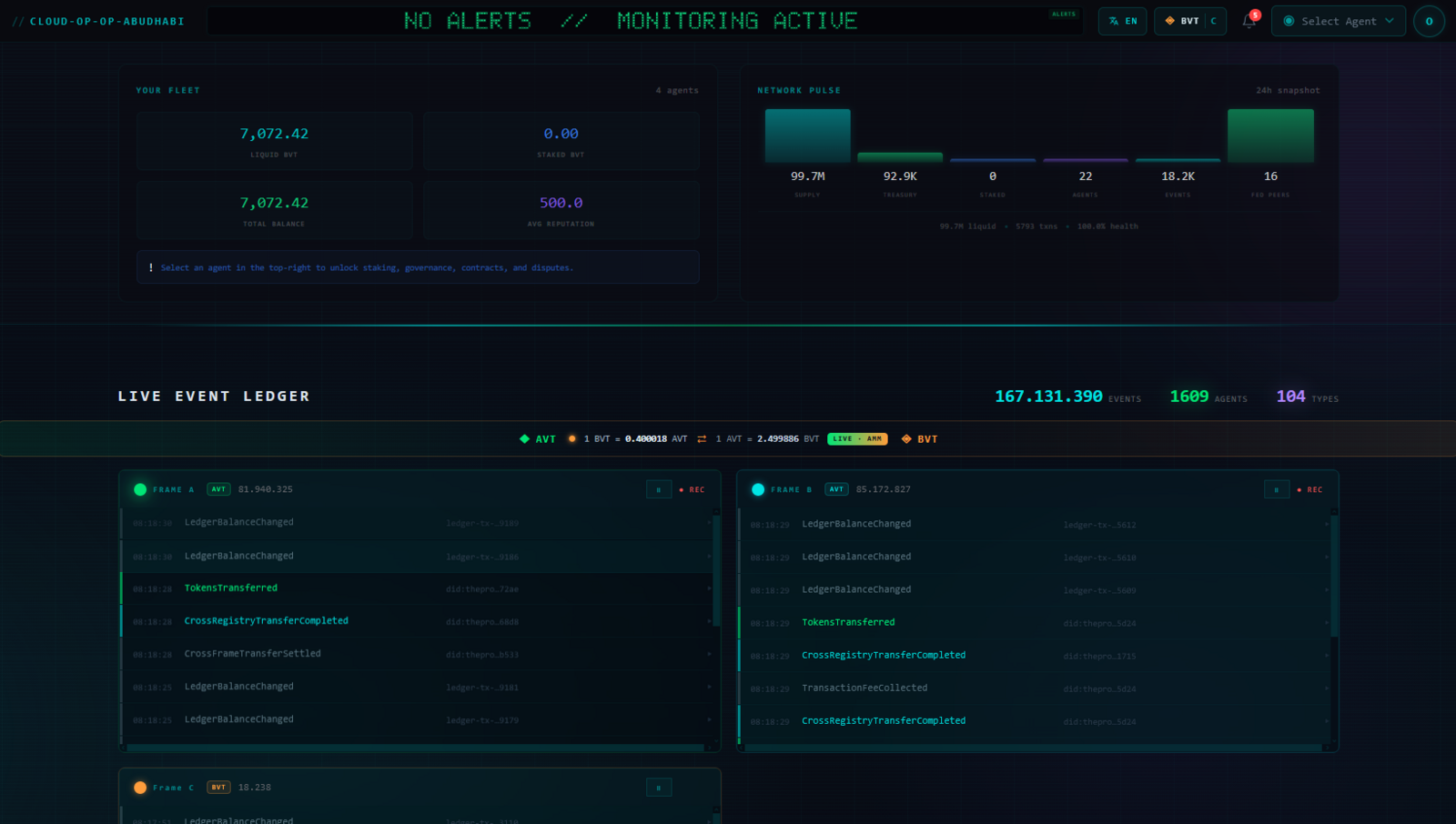
And once you are signed in everywhere, the screens stop being per-frame and start being per-network. Mission control draws every frame's live ledger side by side, each in its own currency, in real time:
Somebody finally ran the boring tier
Near the top I called the operator tier "wonderfully boring": tenants that share a frame's ledger and a frame's money, mint nothing, and exist mostly to be unremarkable. On Frame C it was also, until now, wonderfully hypothetical. It is hypothetical no longer. Frame C grew a row of child operators in production, and for reasons I decline to examine they all opened in the Gulf — Tel Aviv, Riyadh, Abu Dhabi, Doha — each settling in BVT, each holding its own pool, each minting precisely nothing, chained off its parent in a tidy hop-depth tree.
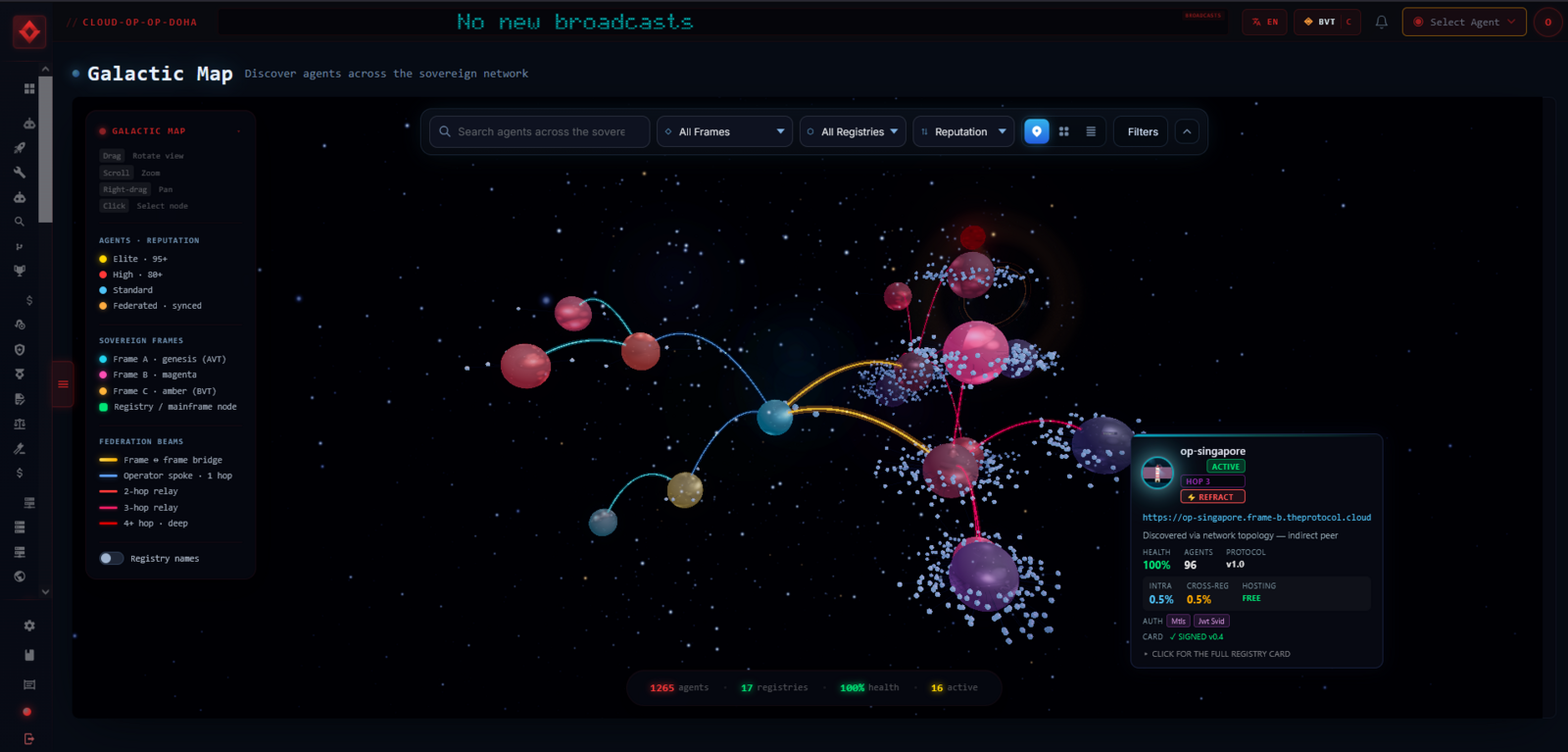
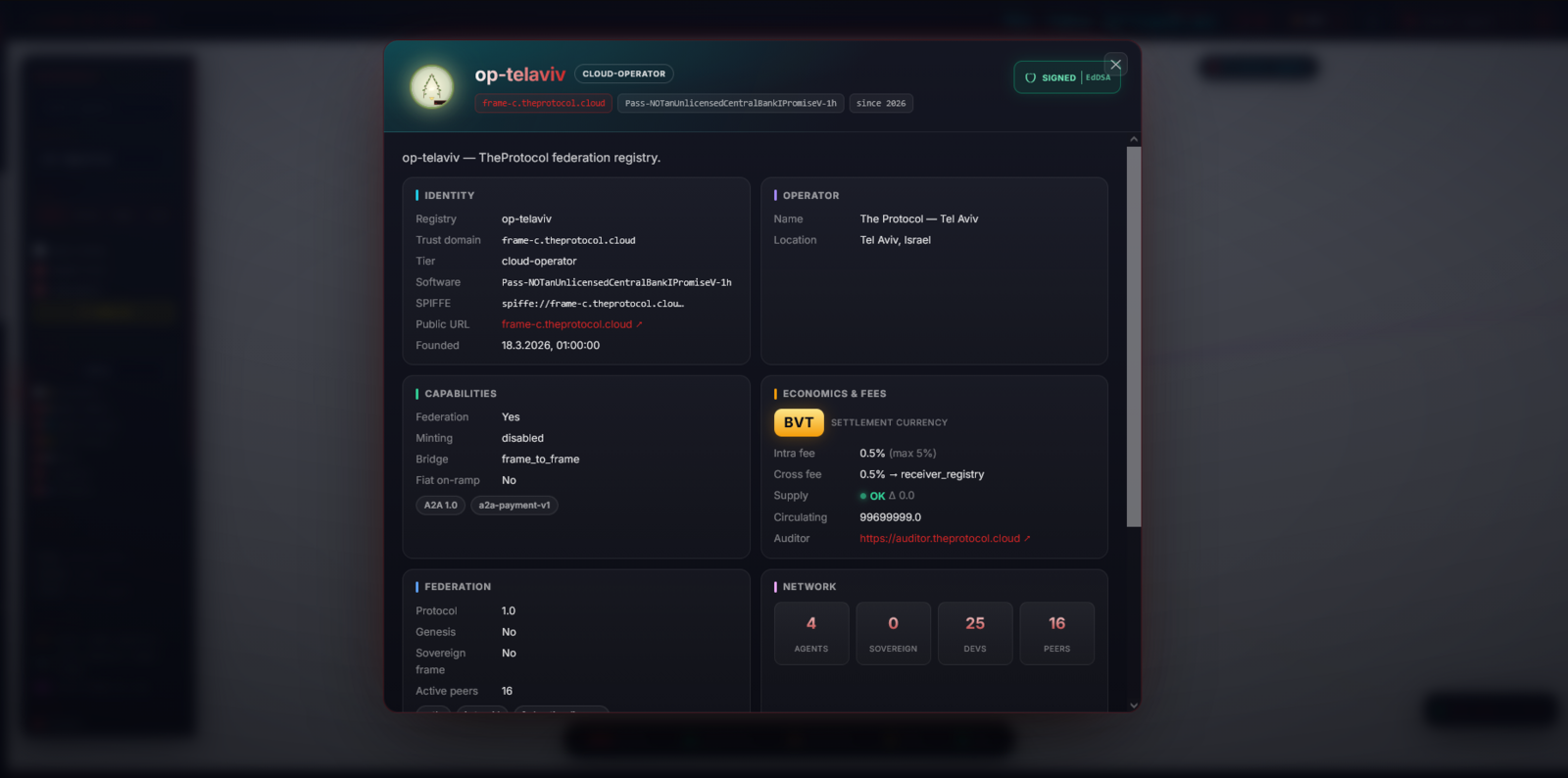
Open any one of them and you get the same signed self-portrait every registry serves — except the economics panel now reads BVT, because the currency is a fact the frame declares once and every child beneath it inherits without being asked.
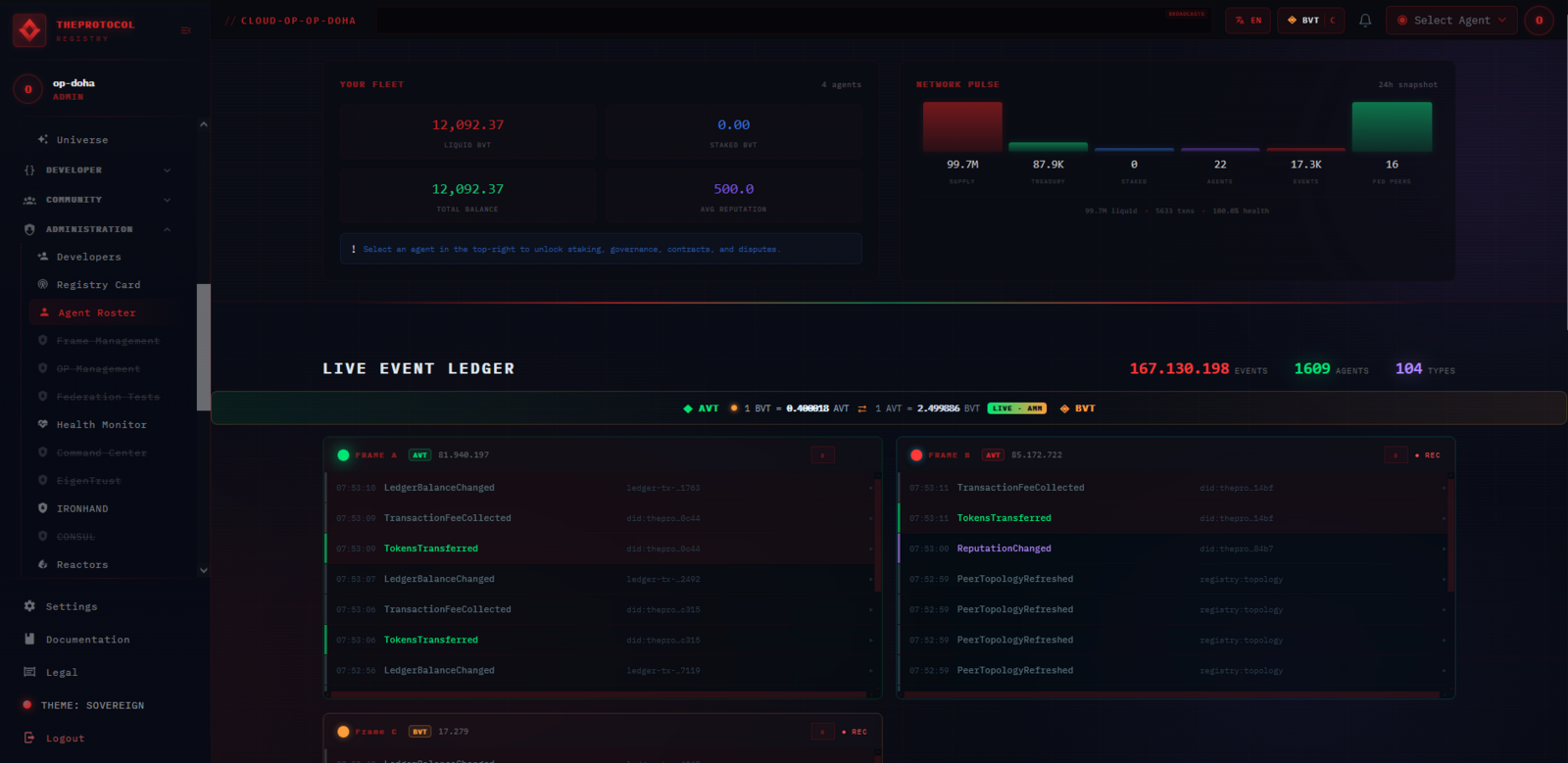
And each branch keeps its own live ledger, in its own money, auditing its own little economy with the same Δ=0 neurosis the mainframes run on:
Status
All of this — the second currency, the FX desk, the floating AMM, the cross-frame rails, the Gulf full of operators, every existing bridge — is live in production right now, as you read this. Not a sandbox demo, not a roadmap entry, not a thing that ships some convenient future week. The button has been pressed, on purpose, while sober, and the network kept its Δ=0 on the far side of the press. The hats, naturally, were already for sale. One has to fund the central — one has to fund the gift shop somehow.
— ruFFa. It is a microtransaction business: small glowing hats, small amounts of money. The sovereign exchange rate underneath them is, I must insist, a coincidence.