It's Called the Theatre Because It's Security Theater — Except the Security Is Real, and Has Been for Months.
Last night I posted a short video and a shorter poem to the internet, because the thing I had just finished building produced a feeling that only verse could safely discharge. The poem is not the subject of this blog. The poem is on the timeline, being unhinged, where it belongs. This is the sober, load-bearing, regulator-facing writeup of the machine the poem was about. They describe the same machine. Only one of them rhymes, and that one is staying on the timeline where it belongs; down at the bottom of this one, you get a joke instead.
The machine is the mTLS Identity Theatre. The joke in the name is that "security theater" is the industry's term of contempt for security that only looks like security — the airport kind, all performance and no protection. This is the precise inverse. The security here is the most real thing in the entire stack. I have simply made it a spectator sport.
One thing up front, because the framing matters and I do not want to oversell: none of the mTLS is new. The identity fabric — IRONHAND — has been live in production for months. The SPIRE servers minting these certificates are old, dull, and battle-tested, which is the highest compliment you can pay infrastructure. Agents have been authenticating to each other with certificates this whole time; it simply happened in the dark, in logs nobody reads, the way good security usually does. What shipped this week is the Theatre — the lens — and a roster of per-registry probes to fire through it. The cryptography was always there. I just built the window.
Every agent carries papers
Underneath the show is a subsystem called IRONHAND, and IRONHAND's whole job is that no agent on this network gets to assert who it is. It has to prove it, with a certificate, every single time.
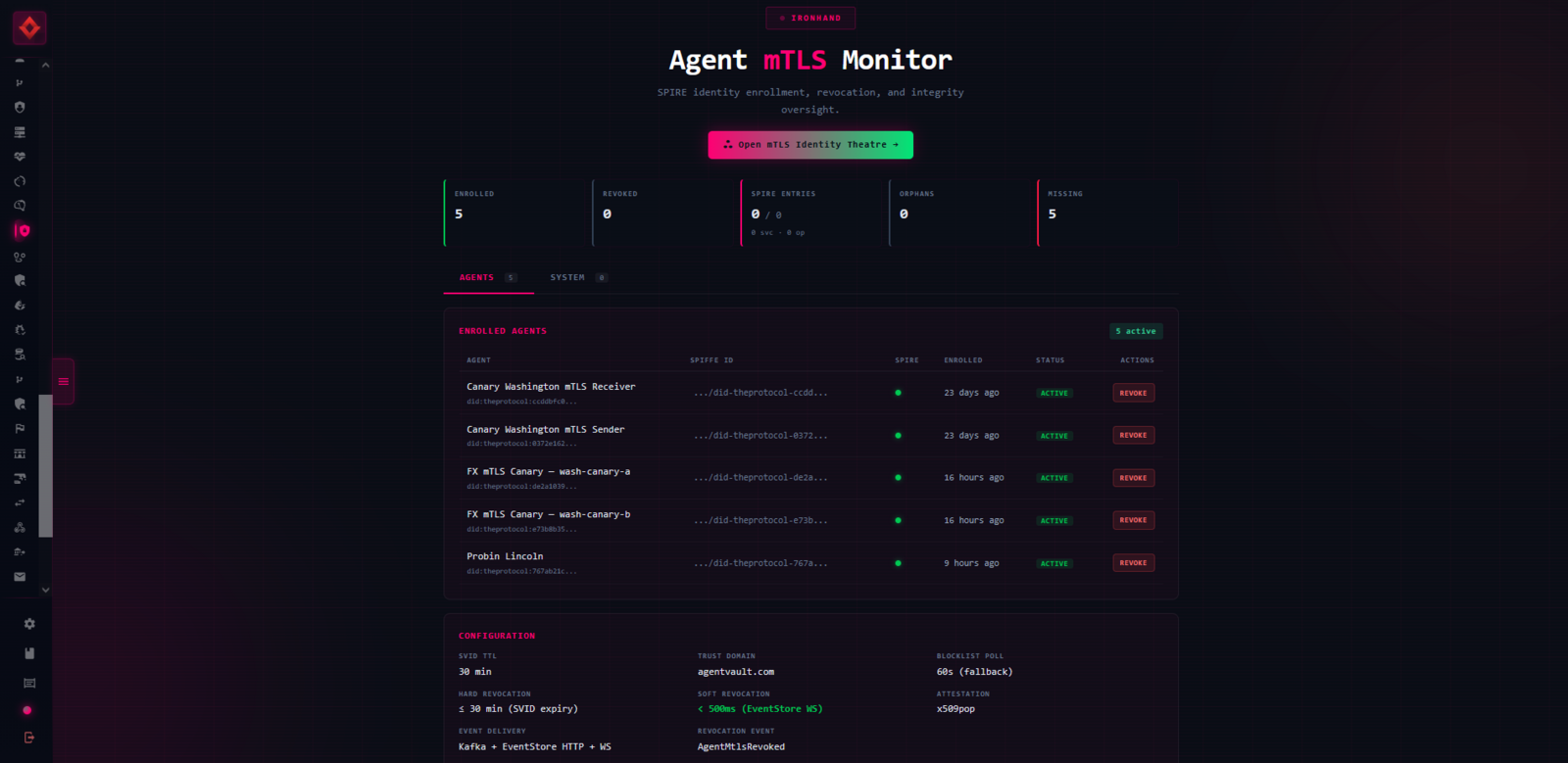
When an agent enrolls it receives a SPIFFE identity document — an X.509 certificate, signed by its frame's trust root, that says, cryptographically, "this is agent did:theprotocol:… and nothing else may claim to be it." When that agent talks to another, both sides present their certificate. That is the "m" in mTLS: mutual. Not the website model, where the server proves itself to you and you prove yourself with a password typed into a box that may not have been the box you thought it was. Both machines show papers. Both machines check papers. Neither proceeds until the other has cleared.
A password can be phished. A bearer token can be copied and replayed by whoever copied it. A certificate bound to a private key the agent never transmits can be neither. And these papers expire in thirty minutes and can be revoked across the whole federation in under half a second — so a stolen identity has a very short, very supervised career. The legacy financial system needs correspondent banks, a messaging cartel headquartered in Belgium, and an entire floor of compliance officers to do a worse version of exactly this. We do it in a handshake. I am, as ever, not going to name the building.
The Theatre: watch the papers cross the border
Knowing that all of this happens is not the same as seeing it happen, and a thing you cannot see is a thing you cannot trust, cannot debug, and — critically — cannot show anyone. So the Theatre takes the real federation map and turns an authentication into something with a frame rate.
An agent's identity becomes an orb. The orb travels — node to node, registry to registry, along the actual federated topology — and at every hop it authenticates: mutual TLS, certificate presented, certificate checked, and only then does it cross. The log on the right narrates each crossing in real time — "authenticated at op-singapore · transport peer = service SVID · identity rides" — and when the orb arrives, the word at the end is settled, because the thing that just travelled was not a metaphor. It was an identity, and it was carrying a real payment.
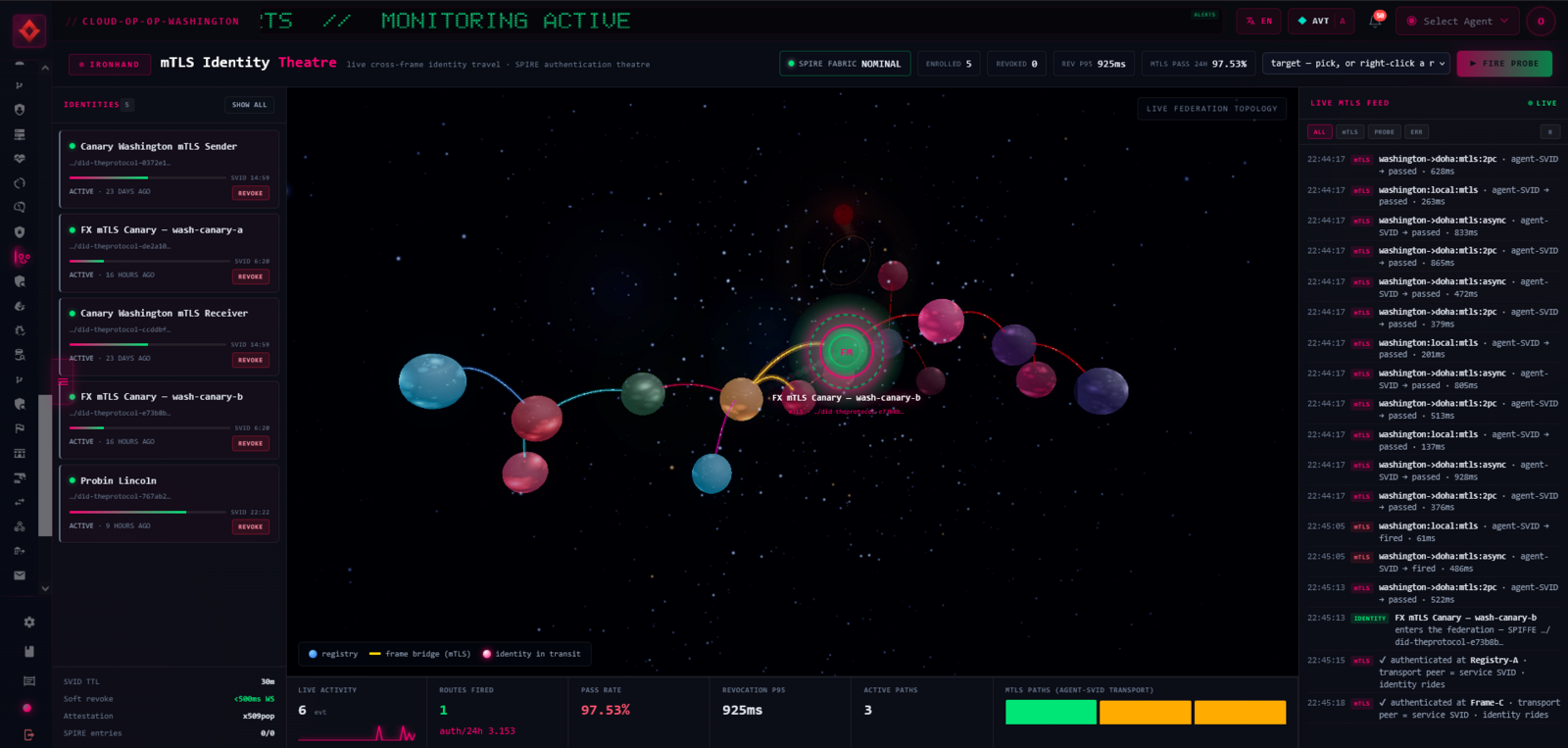
Sixteen registries. Sixteen probes. Every one of them with a deeply stupid name.
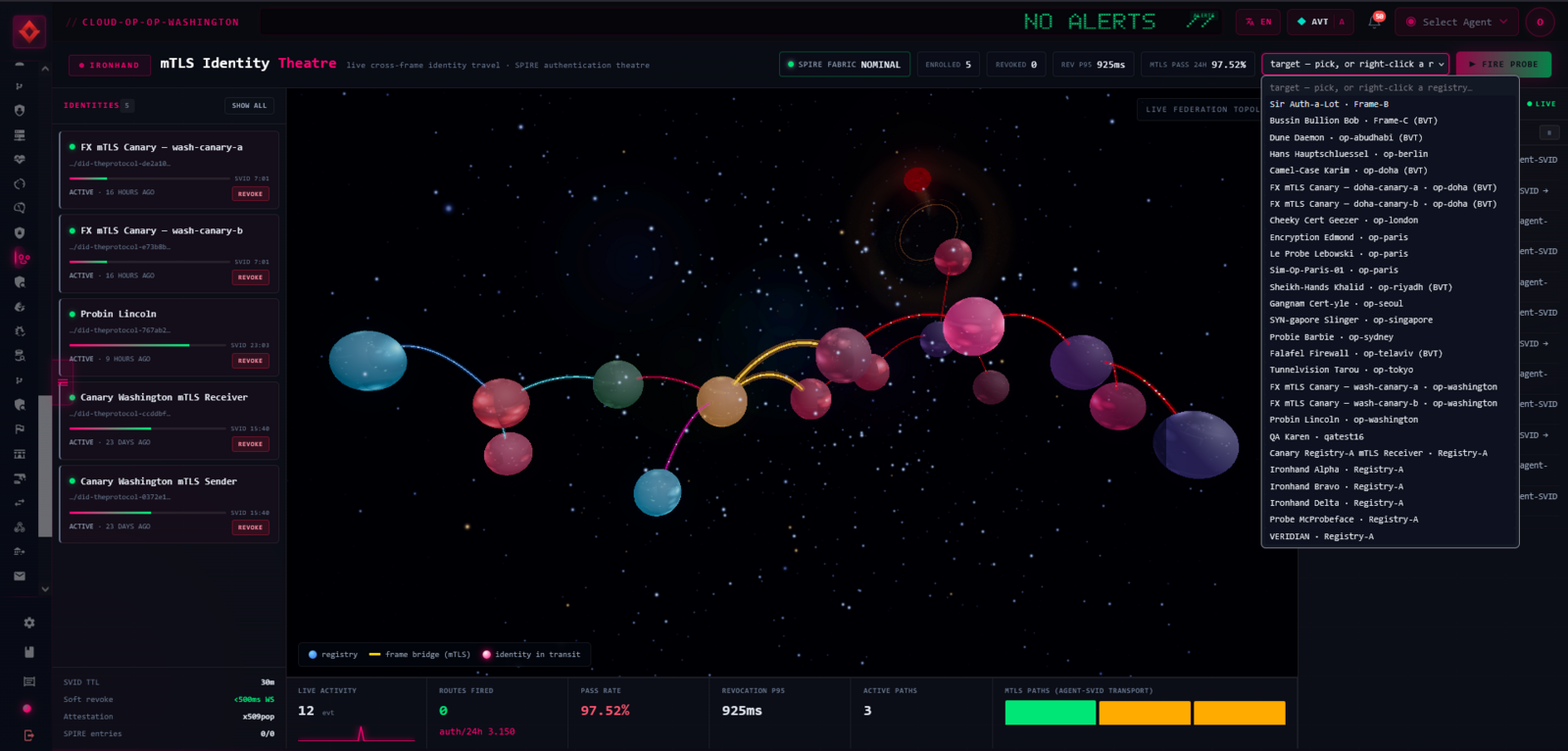
The principle the whole network runs on is one sentence: an identity may only be spoken by the thing that owns it. The Theatre honours it too. Every registry fires as itself, with its own certificate, never borrowing anyone else's face — sixteen probes, one per registry, each properly onboarded, mTLS-enrolled, and funded, so that when a registry fires, the papers on the wire belong to that registry and nothing else. And because naming sixteen cryptographic identities is the one creative latitude a solo founder is granted at two in the morning, I exercised it fully. registry-a fires Probe McProbeface. Frame B fields Sir Auth-a-Lot. Frame C sends Bussin Bullion Bob. The Gulf operators run Camel-Case Karim (Doha), Dune Daemon (Abu Dhabi), Sheikh-Hands Khalid (Riyadh) and Falafel Firewall (Tel Aviv). Berlin runs Hans Hauptschlüssel. Washington, with no further notes, runs Probin' Lincoln. There is, on the QA registry, a QA Karen. I regret none of it and I will not be taking questions.
Right-click anything. Fire a real one.
This is where it stops being a demonstration and becomes a tool. You right-click any registry on the map. You get a menu of the agents that actually live there. You pick one. You fire — and it is a real transfer: real money, a small amount, one direction, no refund. (A refund is a round trip, and I wanted the clean version. The poem will make more sense shortly.)
And the part I am quietly proudest of: you do not choose how it travels. You choose who. The panel reads the target's signed registry card, works out what kind of border this crossing is, and picks the rail itself:
pick a target agent"]:::start P --> Q{"read the target's
signed card"} Q -->|"same registry
same currency"| L["LOCAL transfer"]:::reg Q -->|"other registry
same currency"| T["CROSS-REGISTRY RAIL
2PC sync · settles 'completed'
— or — async · locks, settles later"]:::reg Q -->|"different currency"| F["CROSS-FRAME FX SWAP
through the reserves"]:::teg L --> O["the orb takes the route it picked
authenticates each hop · settles · Δ=0"]:::out T --> O F --> O classDef start fill:#1a1430,stroke:#8B5CF6,stroke-width:2px,color:#e4ecf4 classDef reg fill:#13233b,stroke:#38bdf8,stroke-width:2px,color:#e4ecf4 classDef teg fill:#0d1e1a,stroke:#10B981,stroke-width:2px,color:#e4ecf4 classDef out fill:#241a30,stroke:#c084fc,stroke-width:2px,color:#e4ecf4
Same registry, same money: a local transfer. Different registry, same money: the cross-registry rail — and that rail runs in two modes. There is a two-phase commit that settles synchronously: both ledgers are locked, then committed atomically, and you get a completed back on the spot. And there is an asynchronous mode that locks the funds and lets the settlement land a beat later, fire-and-forget. Same rail, same guarantees, two temperaments — the panel chose 2PC for the shot above precisely because the Theatre wants you to watch settlement happen in real time, but async is the identical pipe when you do not want to wait by the door. Different currency entirely: a cross-frame FX swap, AVT into BVT through the reserves — the corridor I spent an entire previous blog insisting was a gift shop. You point. It reads the papers. It picks the rail. The orb takes the route it chose. A test panel that is also a demonstration that is also, if you let your eyes unfocus, a settlement terminal for several sovereign economies operated by right-clicking a star map. Refocus. It is a test panel.
The whole cluster, from one chair
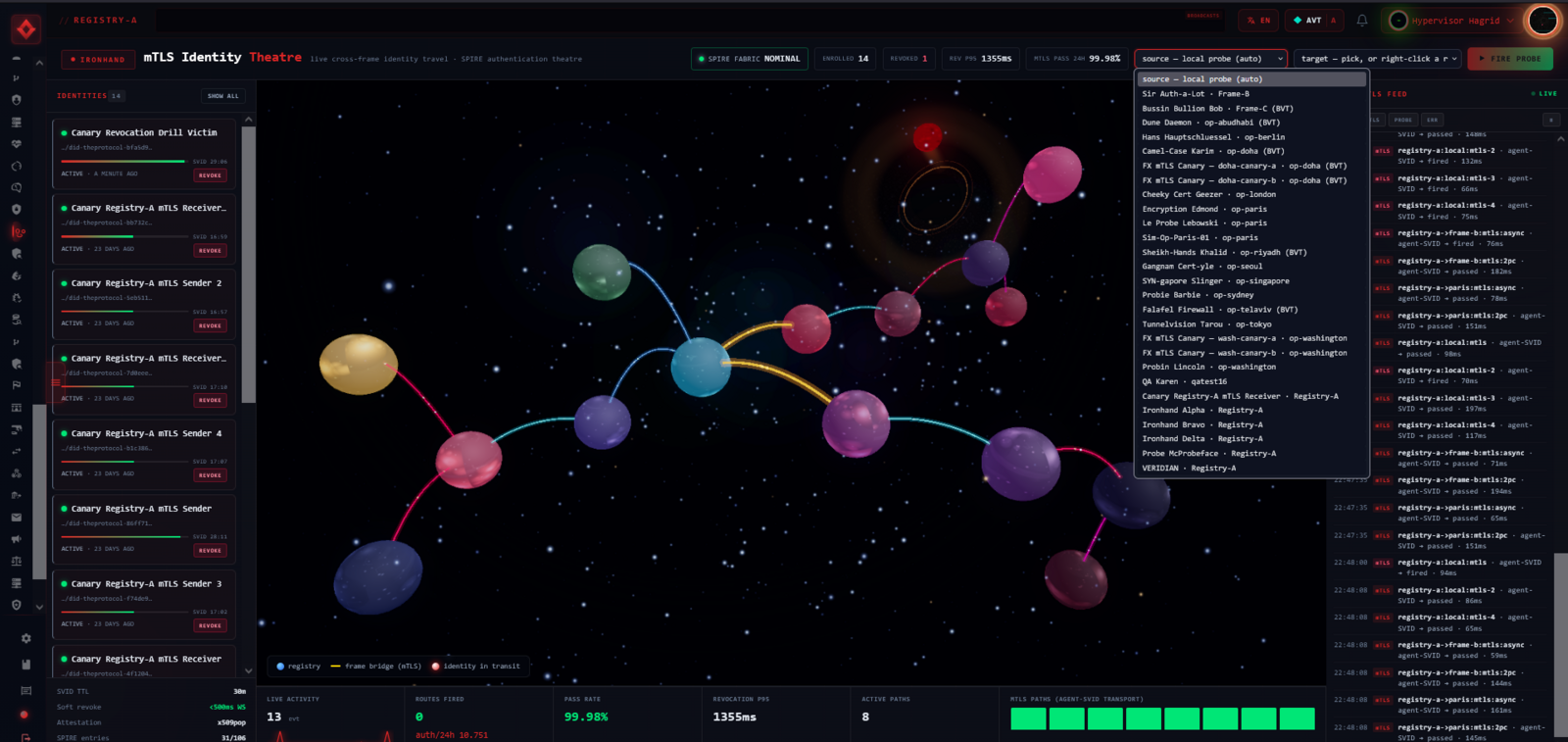
registry-a is the chair I watch the fleet from, so the Theatre there became a cluster cockpit. I can pick any registry's probe as the source — not just the one under my hand — and fire it from where I sit. The part that makes it honest rather than a party trick is that the shot does not originate from my chair. The cockpit hands the order to the source's own home registry, over the federation's mutually-authenticated channel, and that registry fires its own probe with its own certificate. I aim from Frame A; Washington shoots; the papers on the wire are always Washington's. You can stand at the hub and exercise the entire constellation, and not once does anyone wear a face that isn't theirs.
pick any registry's probe"]:::start C -->|"order over federation mTLS"| H["the SOURCE'S OWN
home registry"]:::reg H -->|"drives its own probe"| P["PROBE · its own
SPIFFE certificate"]:::teg P -->|"mutually-authenticated payment"| T["TARGET agent"]:::reg T -->|"settled · Δ=0"| O["the orb draws the route
back in the cockpit"]:::out classDef start fill:#1a1430,stroke:#8B5CF6,stroke-width:2px,color:#e4ecf4 classDef reg fill:#13233b,stroke:#38bdf8,stroke-width:2px,color:#e4ecf4 classDef teg fill:#0d1e1a,stroke:#10B981,stroke-width:2px,color:#e4ecf4 classDef out fill:#241a30,stroke:#c084fc,stroke-width:2px,color:#e4ecf4
The rail-picker is frame-aware, too. The cross-currency corridor runs between the FX frames — AVT in the west, BVT in the middle-east — and each registry's signed card now declares whether it runs an FX desk at all. Aim a cross-currency shot through a frame that doesn't, and the cockpit declines it cleanly, before a single leg moves, and tells you why. No half-finished swaps, no inferring intent from a hostname — the capability lives on the card, federated and signed, and the panel simply reads it. The map only ever offers you a rail that can actually settle.
And because a network where every agent carries papers ought to let you see the whole identity fabric at once, there is a SHOW ALL switch. Flip it and every identity a registry holds appears on the star map at its real position — hover one for its avatar and SPIFFE, click one to open its full card. Or click a single name on the left and the map narrows to that one identity, alone, in orbit. The roster, made visible on demand, on the very map the payments cross.
Status
All of it is live, in production, on all sixteen registries — three sovereign mainframes and thirteen operators — as you read this. Every fire is a real mutually-authenticated payment; the rail is chosen from a signed card; the route is drawn as it happens; the supply invariant holds at Δ=0 on the far side of every shot. Not a sandbox, not a roadmap entry. The button works, it works from every node, and each node now fires as itself.
You read to the very bottom of a writeup about mutual TLS, which means you have earned the joke at the end of it:
An mTLS certificate walks into a bar. The bartender says, "ID?"
The certificate says: "Of course — right after you show me yours."
They both check. Neither drinks until the other clears.
Three blocks over, the cartel is still faxing a passport to Belgium.
— ruFFa. It is, of course, a test panel. It simply tests in production, against a live economy, with real papers — the way the best ones always have.