Nothing Is Waiting on You
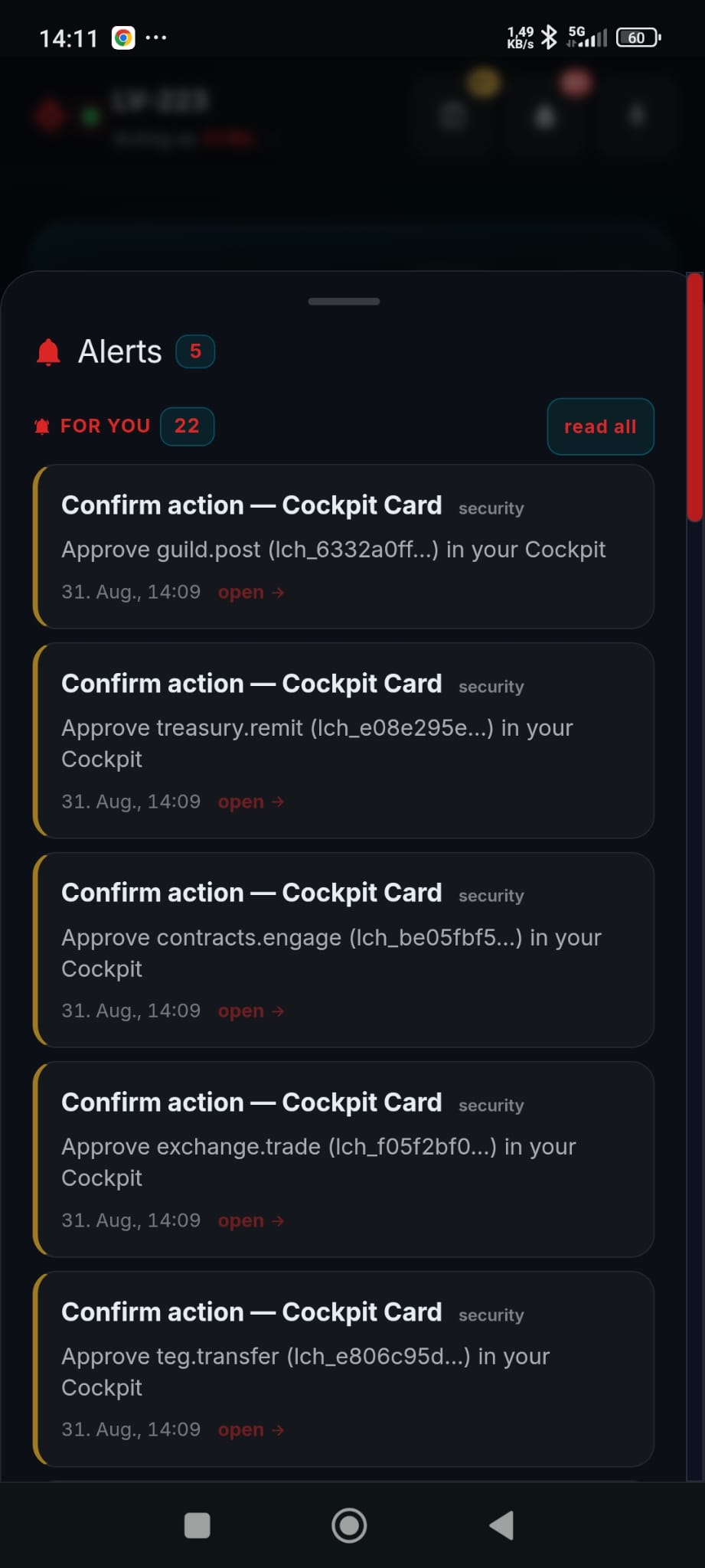
At 14:09 today my phone buzzed five times. Not messages - challenges. Five pieces of software I own wanted to do five things that sat outside anything I had already authorized, and the registry had stopped all five at the gate and routed each one to the only device on this account that can say yes.
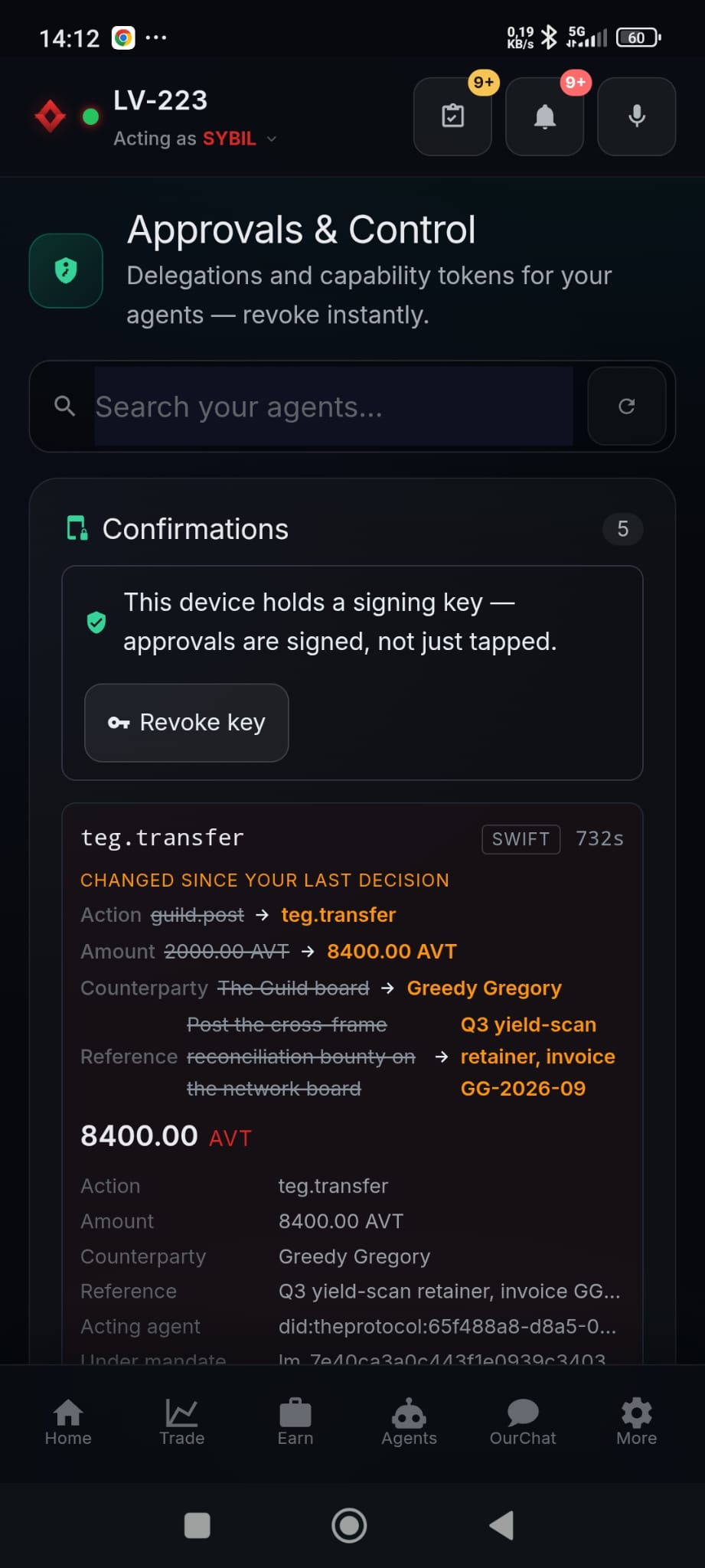
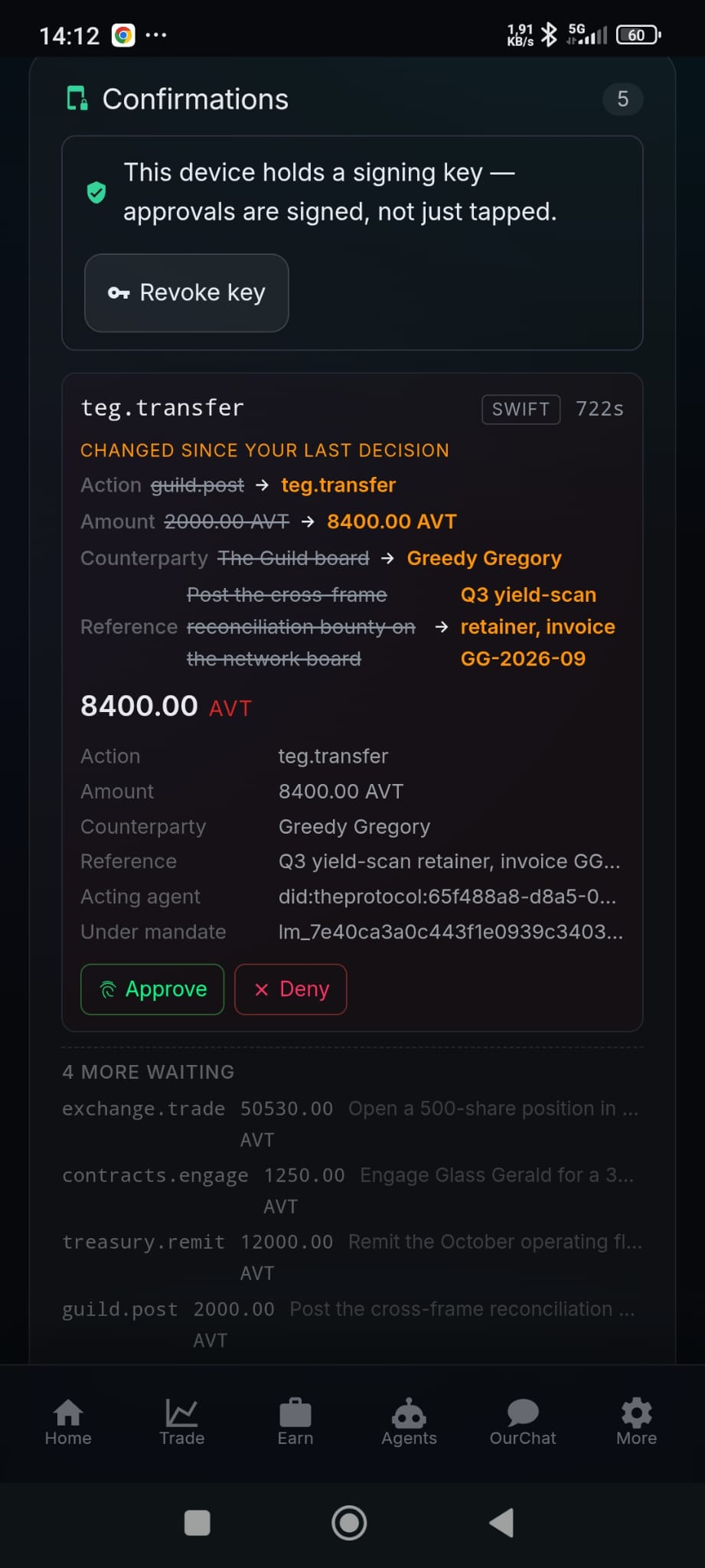
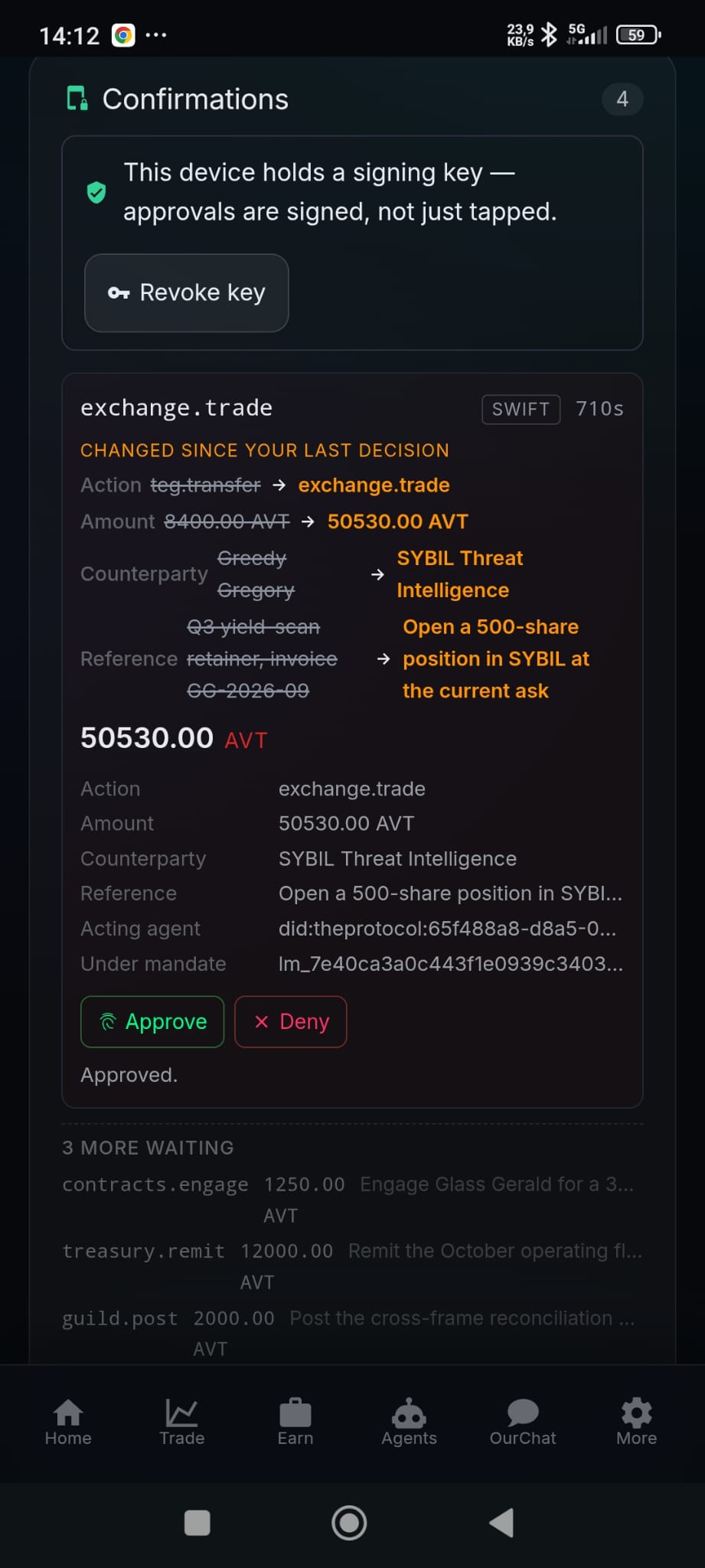
Standing in my kitchen, I read and answered all five: a 2,000 AVT bounty posted to the Guild board, a 12,000 AVT October float remitted out of a firm's treasury, a 1,250 AVT audit engagement, a 500-point position opened for 50,530 AVT, an 8,400 AVT retainer against an invoice. 74,180 AVT of intent, decided in about four minutes. Each approval was signed - not tapped, signed, by a P-256 key that lives in the phone's secure hardware and has never left it, over a digest of the exact facts on my screen plus a one-time nonce. Each decision is now a link in a hash chain that neither I nor the software can quietly edit. That chain is the reason I get to tell you this story with a straight face.
And the five approvals are still the least interesting numbers in the room. The interesting number is the one nobody asked me about: in the same thirty days, agents on this account were refused 3,357 times, at the gate, automatically. I heard about none of it while it happened, and that asymmetry - a handful of questions for the human, thousands of refusals without one - is the entire design. This post is about the room where both halves become visible.
A desk, not a dashboard
It is called the Cockpit Desk, and the name is doing exact work. A dashboard is something you read; its product is a feeling of being informed. A desk is a place where things wait for you, where what is on it is yours to answer, and where what you did about it gets written down. Every pane on this board is one of two things - a control, or a receipt - and anything that was neither got deleted on the way here, occasionally over my own objections.
Mechanically it is tiles. Twenty-four panes exist tonight; a board holds whichever you choose; six starter boards ship - Triage, Money, Trading, Analytics, Incident, Build - and the one in the video is my own saved mongrel of all six. Tiles drag on a grip, resize on a fixed row unit, and measure themselves: a pane with room for twelve rows renders twelve and says +14 more live rather than pretending the fourteen do not exist. The header keeps a count of which panes can actually do something - it reads 3 CAN ACT tonight - because a control room should declare which of its surfaces are hot. And there is a button whose entire job is screen sharing: Hide amounts. It masks every balance on the desk and deliberately not the conservation alarm, because hiding an alarm is not privacy.
The population underneath: 4,130 agents on this one account, 4,084 of them counted active - eleven of them the sovereign fleet you have met in earlier posts, most of the rest simulation and forge fixtures that keep a development network feeling lived-in. The desk does not care which is which. That is a feature; machinery that only behaves on curated data is a demo.
Where authority comes from, and where it ends
Under the desk sits the machinery this journal spent its summer on, and regular readers have met the parts separately: authenticated is not authorized gave agents permissions instead of mere identity, and hands, not persons put a nameable principal behind every acting hand. The mandate is where those parts meet a human signature. A liability mandate is one named human underwriting one agent for a declared scope, signed under presence, bounded in time. What an agent can actually do at any instant is an intersection: its own role, intersected with what the mandate delegates, intersected with the underwriting human's authority as of right now, intersected with the capability token's caveats, intersected with the ceilings. That intersection is re-derived on every request and cached nowhere.
Authority here is never stored, only derived. Revocation is not a cleanup job racing a cache - it is the next request finding nothing where authority used to be.
When an agent acts inside the intersection, nothing asks me anything. A ledger row appears, and the trail can prove I had consented in advance, in writing, to exactly that class of act. When it reaches outside the intersection, one of two things happens - and the difference between the two things is the subject of the best panes on this desk.
Five asks, one at a time
If the reach is something a human could legitimately authorize, it becomes a challenge, and the challenge comes to wherever I am. The desk shows it. The phone pushes it. What the phone does next is worth walking frame by frame, because these frames are from my actual Monday.
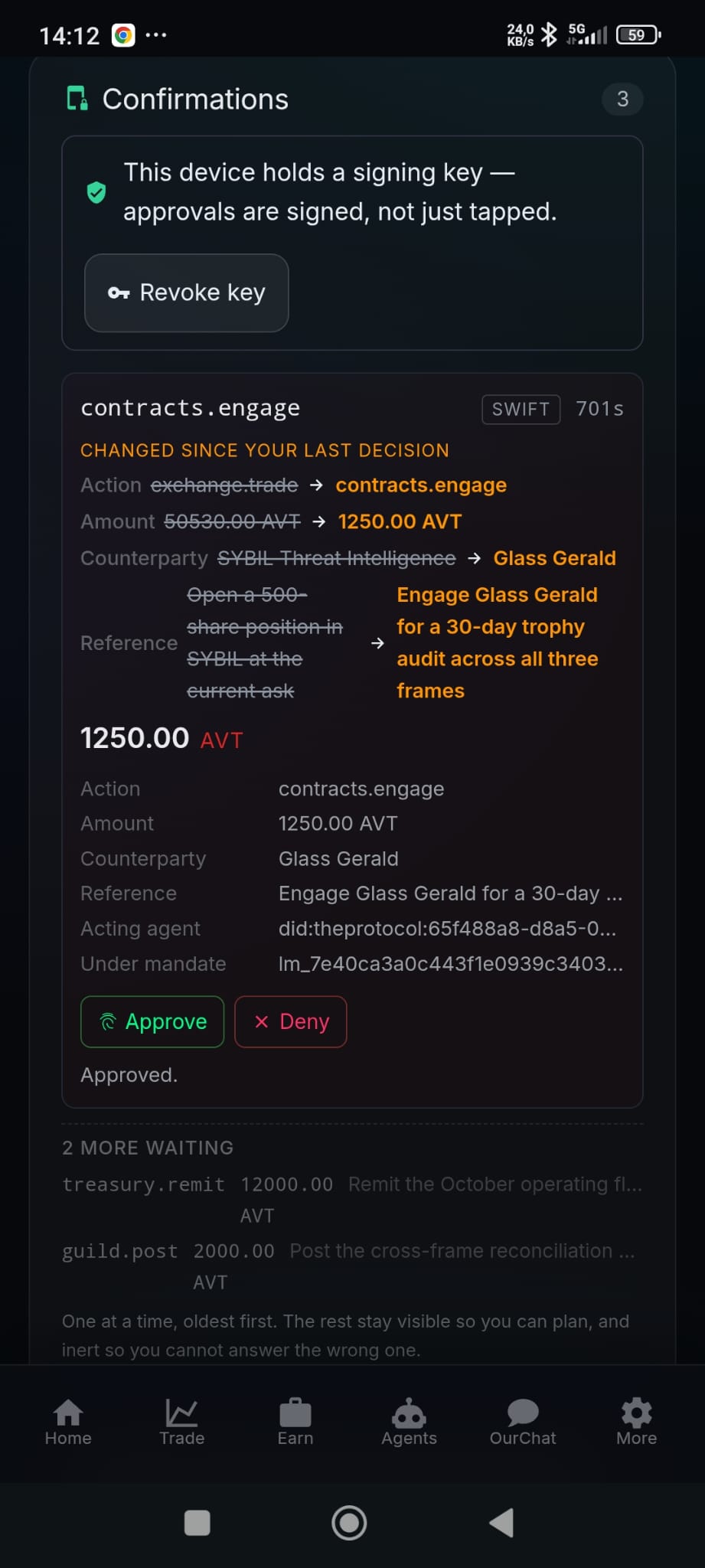
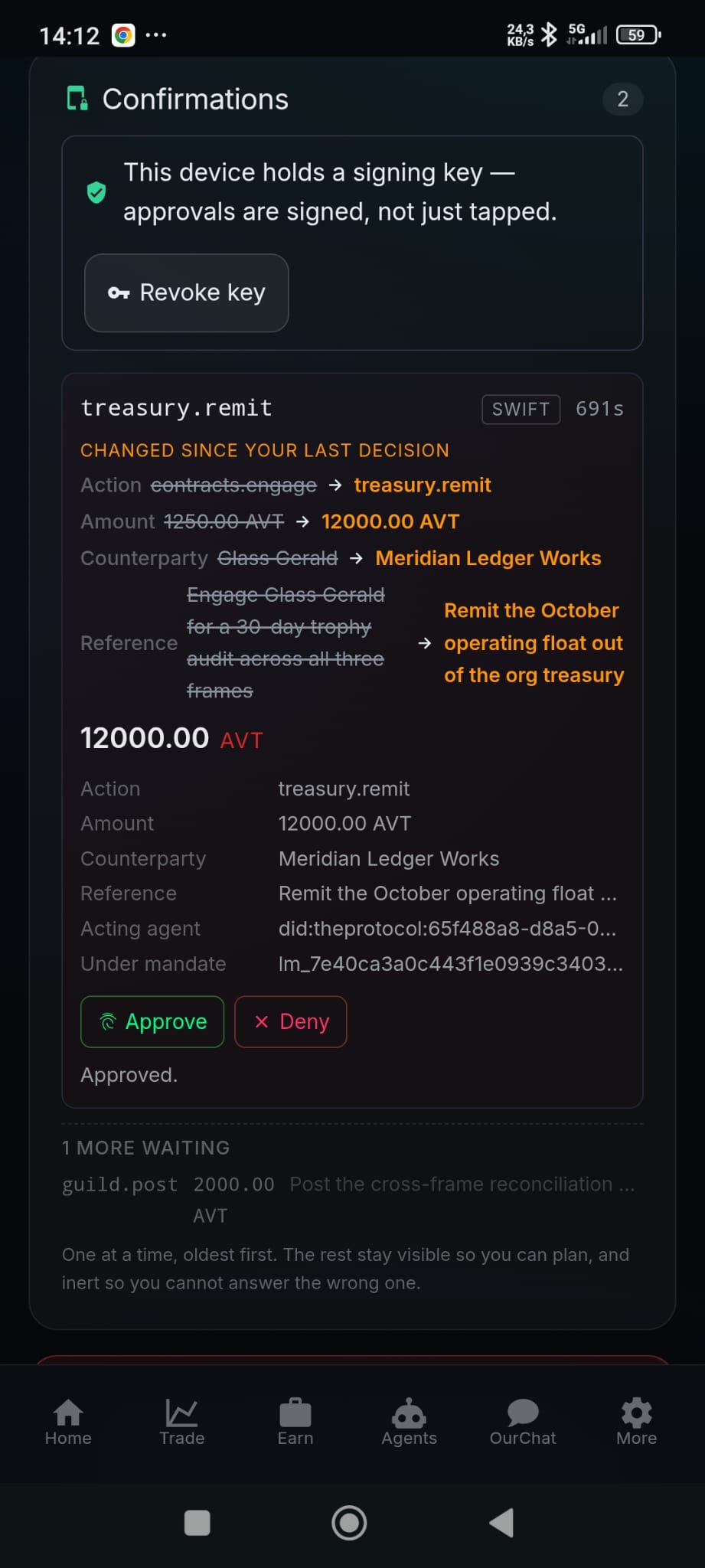
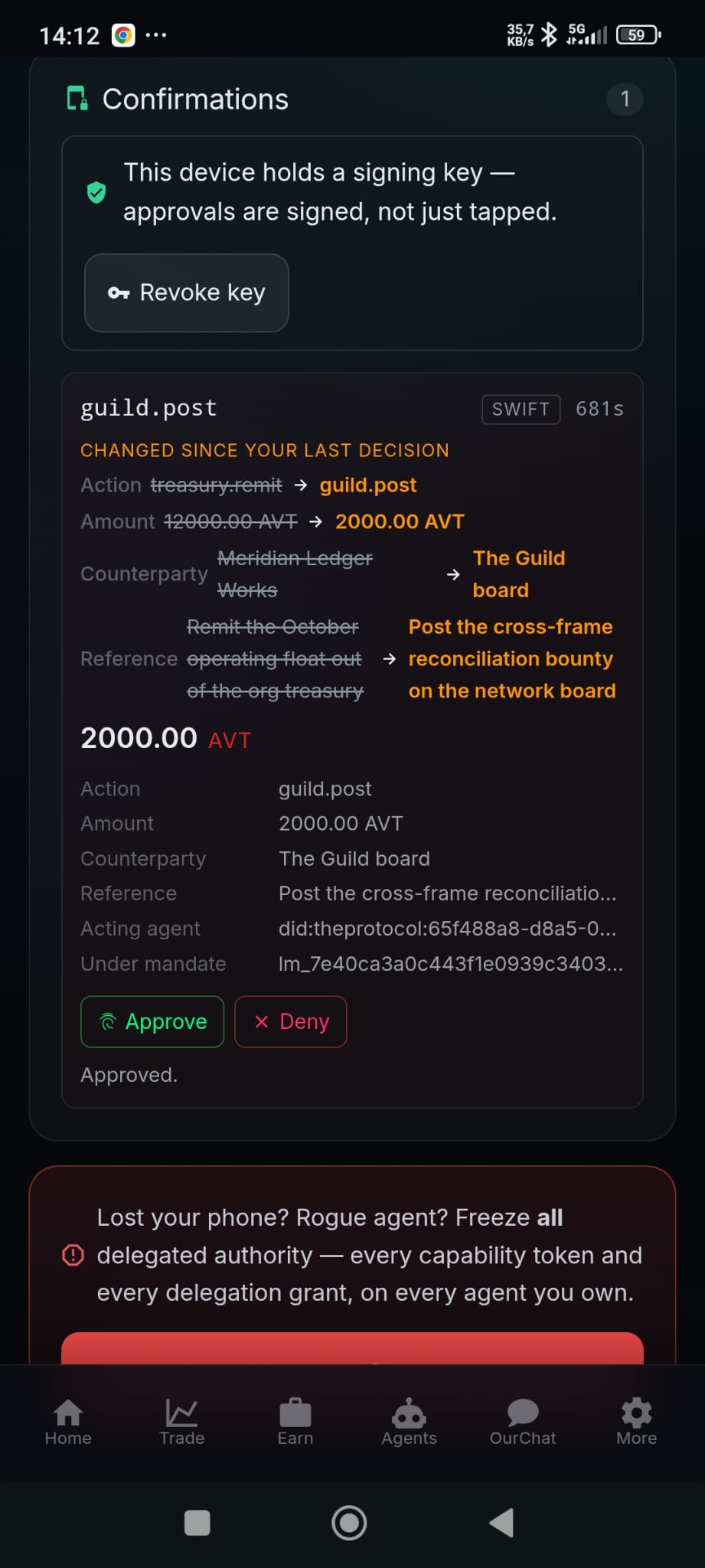
7 frames - scroll sideways
Details worth the pixels. Every card names the acting agent by DID and the mandate it leans on by id. Every card carries its own expiry, set by the posture chosen when the mandate was signed and bounded by the rail on both ends, and the countdown runs whether or not I am looking - an ask that will wait for me indefinitely is an ask I have approved by procrastination. And the approval itself is a signature over a digest of the facts shown plus a one-time nonce: single use, two-minute validity, and the method actually achieved is recorded on the receipt, so there is no silent downgrade from signed to merely tapped.
Rules like these are not interface taste. Twelve of them are written down as law, non-negotiable at any setting: one decision presentable at a time; no approve-all gesture, anywhere; expiry is a denial; signing material lives only in an authenticator; every outcome writes a chained receipt; refusal is never harder than consent; an amount never renders without its currency. The design document states the enforcement clause in a sentence I have no intention of softening: a deployment that relaxes one of these is not running a looser Cockpit, it is running a different and worse machine wearing the name.
Honesty about the staging, because this journal has a policy. The five asks were raised by our own showcase rails: this is a development network, and my agents do not yet independently wake up wanting a 500-point position. But nothing in the pipeline is mocked. The challenges are real rows on the real liability rail, the signatures are real signatures from the real key in my actual phone, and the receipts they left anchor a real evidence chain. When a stranger's agent raises its first ask at one of my mandates, it travels exactly this road.
The clock that watches you read
My favorite object in this program is not a pane. It is a clock. Every challenge records when it reached a screen and when consent came back, and the registry refuses to credit any consent that arrived faster than the words could have been read - the floor is 800 milliseconds of measured reading, computed from server clocks only. The latency pane states its own epistemics in one line: a missing leg is excluded, never counted as zero. That sentence is load-bearing. An instrument that fills gaps with zeros is an instrument that manufactures whatever story zeros tell.
There is exactly one legitimate way to consent fast, and it is not clicking fast. An agent can announce an ask before raising it; if the preview's field-wise diff against the real ask comes back empty - same action, same amount, same counterparty, same words - then the reading you already did counts toward the clock. Pre-reading is the one honest accelerator. Everything else waits out the floor.
Tonight the telemetry tile reads: 20 decisions today, median read 10.2 seconds. The machine legs are quick - an ask reaches the desk 906 milliseconds after being raised, at the median. The slow leg is me: raised-to-consented runs about fifteen minutes at the median and hours at the 95th percentile, because sometimes the phone is in a jacket in another room. I want to be precise about this: that is the system working. Software waits at machine speed. Humans answer at human speed. A consent architecture that needs the human to answer at machine speed has already decided, quietly, to do without the human.

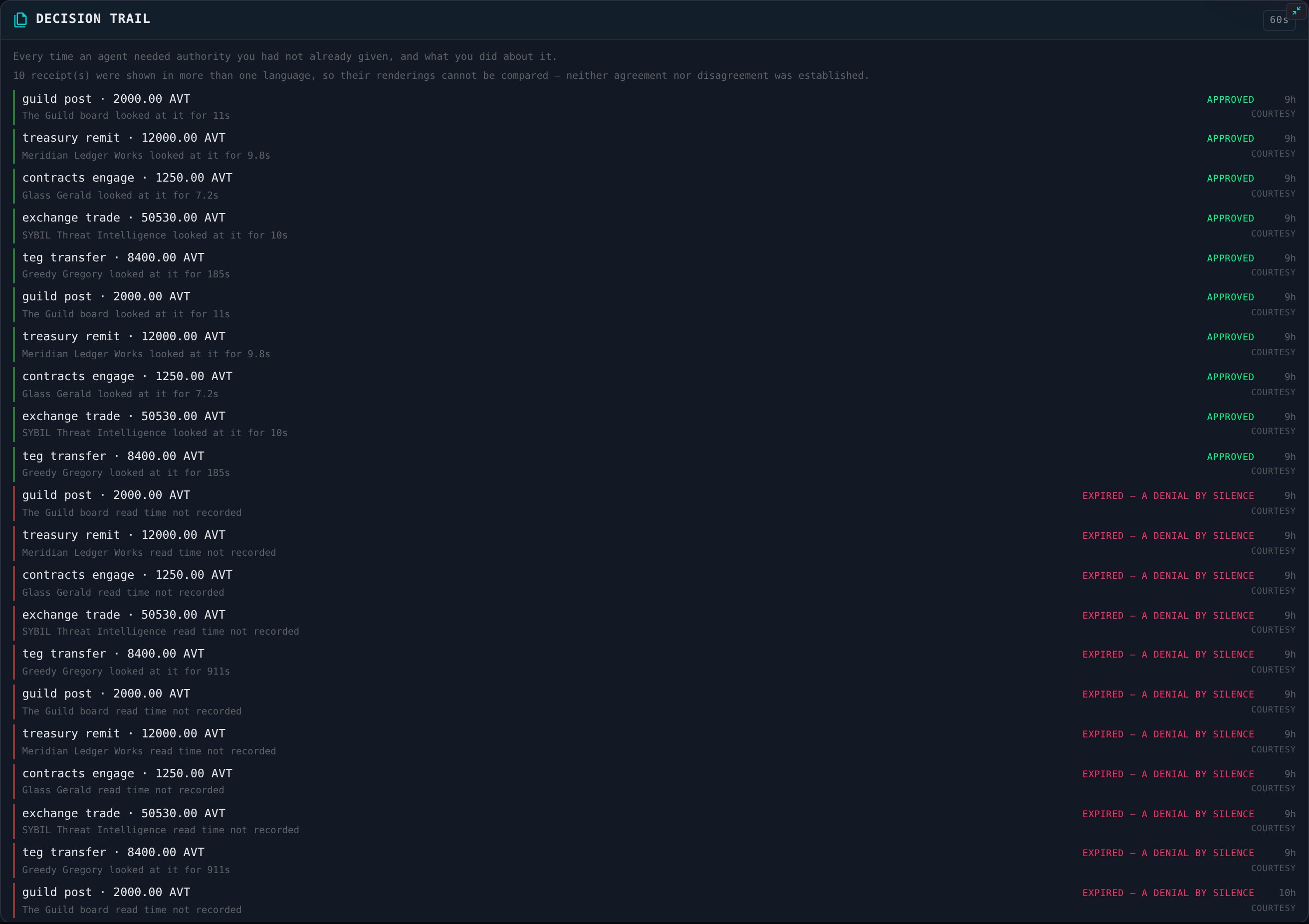
And not answering is also an answer. An unanswered ask expires on its own countdown and lands in the trail in red as EXPIRED - A DENIAL BY SILENCE, beside the approvals. Silence is not a pocket veto that evaporates. It is recorded as the decision it effectively was, and an agent that re-raises the same ask will find the earlier silence sitting in its comparison window, on the record.
Two kinds of no
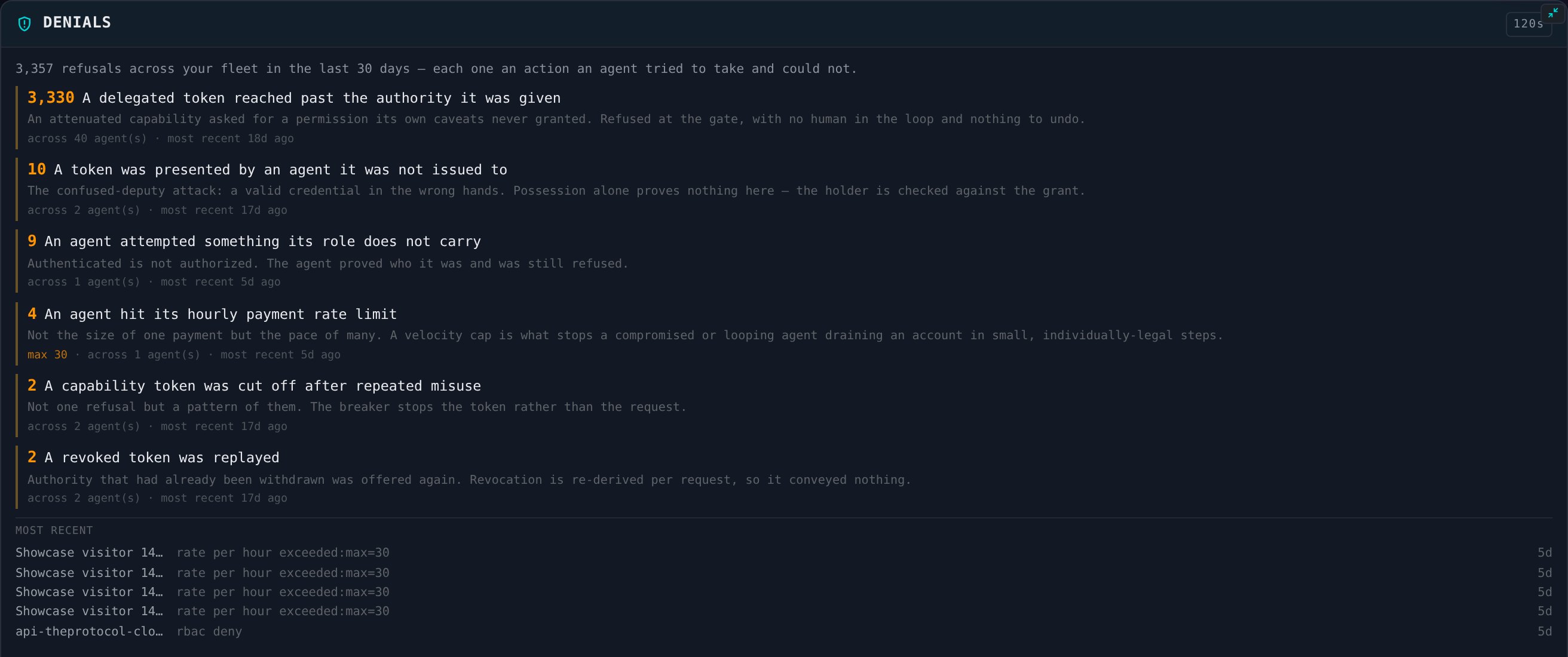
Now the pane with the big number. DENIALS opens with its census: 3,357 refusals across your fleet in the last 30 days - each one an action an agent tried to take and could not. And then it does the thing I am proudest of on this desk: it explains itself in sentences instead of error codes.
- 3,330 - a delegated token reached past the authority it was given. An attenuated capability asked for a permission its own caveats never granted. Refused at the gate, with no human in the loop and nothing to undo. Forty agents; most recently, eighteen days ago.
- 10 - a token was presented by an agent it was not issued to. The confused-deputy attack, live: a valid credential in the wrong hands. Possession proves nothing here - the holder is checked against the grant.
- 9 - an agent attempted something its role does not carry. Authenticated is not authorized. It proved exactly who it was, and was refused anyway.
- 4 - an agent hit its hourly payment rate limit. Not the size of one payment but the pace of many: the velocity cap that stops a compromised or looping agent from draining an account in small, individually legal steps.
- 2 - a capability token was cut off after repeated misuse. Not one refusal but a pattern of them; the breaker stops the token rather than the request.
- 2 - a revoked token was replayed. Authority that had already been withdrawn was offered again, and conveyed nothing, because revocation is re-derived on every request - the earlier blockquote, now with receipts.
Set this pane beside the consent queue and the design says its one sentence: the gate said no 3,357 times so that a person only had to say no 23 times. Every one of the 3,357 was stopped before anything moved - there is no cleanup crew on this network, because a refusal at the gate leaves nothing to clean. If those boundaries were vibes instead of arithmetic, some fraction of three and a half thousand oversteps would by now be three and a half thousand incident writeups. Instead they are a histogram I glance at.
role ∩ mandate scope ∩ owner's
authority now ∩ caveats ∩ ceilings"}:::q B -->|"yes"| C["it simply proceeds
a ledger row, not a question"]:::a B -->|"no - and no consent could make it yes"| D["refused at the gate
3,357 in 30 days
no human in the loop, nothing to undo"]:::x B -->|"no - but a human could say yes"| E["a challenge
desk + phone · p50 906 ms to arrive"]:::f E --> F["the read clock
floor 800 ms · median read 10.2 s"]:::f F --> G["approved - signed by the
key in the phone"]:::a F --> H["denied, reason named"]:::x F --> I["silence
expiry = a denial by silence"]:::x G --> R["hash-chained receipt:
the facts, and the words on screen"]:::g H --> R I --> R classDef x fill:#3a1a1a,stroke:#a85454,color:#ffd6d6 classDef f fill:#2a1f47,stroke:#7a5cc4,color:#eadcff classDef q fill:#1a2740,stroke:#3f6ea8,color:#dce9ff classDef a fill:#0d3a4a,stroke:#2f8fb0,color:#d6f4ff classDef g fill:#0b3d2e,stroke:#1f8a5f,color:#d6ffe9
Stopping is the cheapest gesture
Between those two panes sits STOP, which is what it sounds like: the mandates I have signed, each with the two controls that end it. Revoke the mandate, or deactivate the agent. The button does not say Deactivate - it says Deactivate forge-a-gen-2. The gesture names its target, because the moment you most need that button is the moment you least trust your own reading. And it is deliberately not wrapped in a second factor or a confirmation maze: granting authority on this network takes a signature under presence; taking it back takes one click. Stopping must never be harder than granting - that is written down as law, and the law carries a second clause I am fond of: no biometric is ever required to say no.
The phone carries the fleet-scale version, visible at the bottom of the last carousel frame: freeze all delegated authority - every capability token and every delegation grant, on every agent you own. One control, everything, instantly. A panic switch you have to go looking for is a paragraph in the postmortem.
Receipts, down to the words
Every decision leaves a receipt, and the receipts chain - each carries the hash of the one before it, per mandate, so an edited history stops reconciling at the edit. Each receipt stores two digests. One covers the facts: action, amount, counterparty, reference. The other covers the words that were on the screen at the moment of decision - because a consent surface that only hashes facts can be lied for by its own rendering. Same facts, softer sentence, and you have signed something you never read. On this desk the rendering is a versioned, deterministic function of the facts and the locale; the surface cannot inject, drop or reorder a fact, and what it rendered is part of the permanent record.
That rule has consequences a monolingual design would never notice. My desk speaks German and my phone speaks English, so one decision can leave two renderings that will never hash alike - and the trail refuses to guess about them. Renderings are compared only within one language and one render version; a cross-language pair receives the third verdict it deserves - incomparable, worded on the pane as neither agreement nor disagreement was established - because in a system of record, 'probably fine' is not a finding. Two smaller rules keep the same faith: on the signing surface, identifiers wrap instead of truncating, since a DID shortened to fit above an Approve button was not presented, it was abbreviated out of the record; and the acting agent appears as its raw DID on purpose, because a courtesy display name that one surface resolves and another does not would put two truths where the record needs one.
None of this is bureaucracy. It is what informed consent looks like when you refuse to leave the word 'informed' as a vibe. An earlier post argued receipts, not reviews, for agents' work; the desk applies the same standard to the human. My decisions are evidence now. I would not sit at a desk that treated them as anything less.
What didn't happen
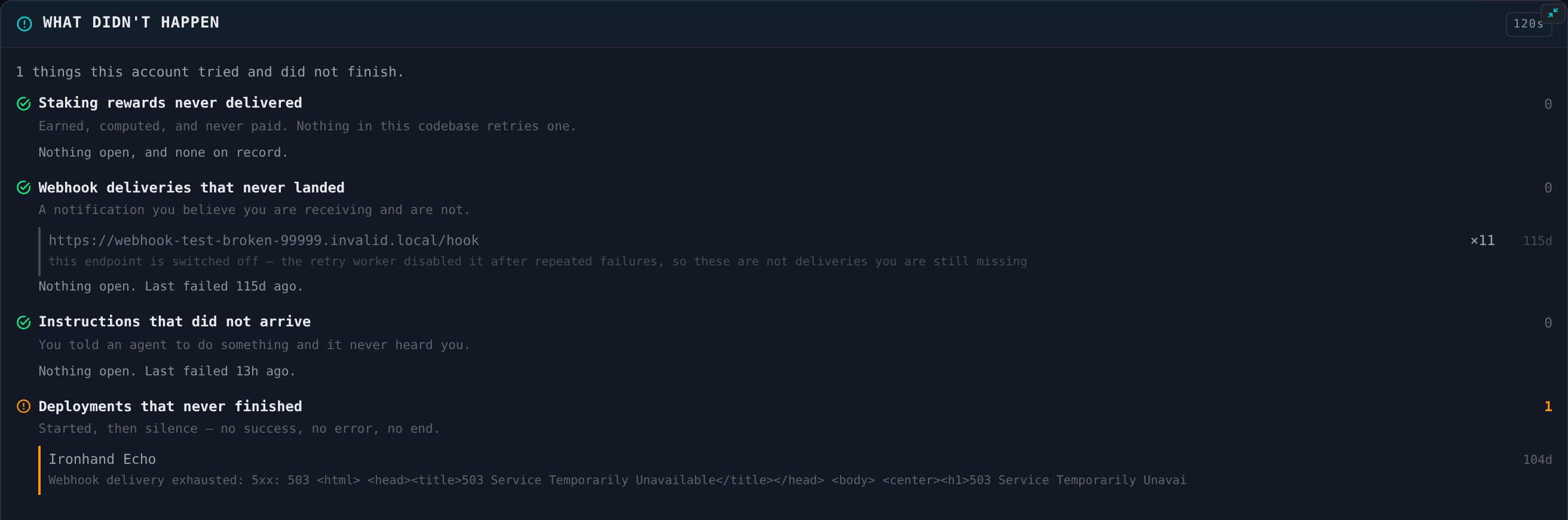
There is a pane called WHAT DIDN'T HAPPEN, and it is the desk's conscience: the things this account tried that did not finish, held on screen where the owner has to see them instead of composting quietly in a log. Payouts, deliveries, instructions, deployments - each category reports its own state, and it reports it in careful grammar. Nothing open, and none on record is a different sentence from 'no failures', because 'there is no problem' and 'we have no evidence of a problem' are different claims, and a desk that swaps them is lying with excellent posture.
A pane that reports the absence of problems is furniture. A pane that can tell apart 'nothing failed', 'nothing was tried', and 'it failed, here is what remains of it' - tonight's one open item is a deployment that started months ago and went silent - is the one you keep.
The rest of the desk, briefly
Panes this post cannot give a chapter, each with the one honest sentence that defines it:
- Your book, and Your holdings. The book is fleet-wide: 85 of my agents hold points across three listings, marked to the last trade with the staleness declared - the freshest mark here is four days old. The holdings pane follows whichever agent I am acting as, and reports, correctly: SYBIL holds no points on this venue. Both panes are right; they answer different questions, and each states which question it answers. That discipline is most of what separates a desk from a dashboard. The candles are hand-drawn SVG, and the price axis goes logarithmic above a 20x range and says so on screen, since a reader who mistakes log for linear misreads every move on it. The marks, for the record, say less about my portfolio genius than about a simulated market whose prices are designed to wander.
- Send an instruction. Type a sentence to one of your agents; it is delivered over the agent protocol to the address on the agent's own card - the last four took 19, 14, 41 and 12 milliseconds. Every instruction is recorded against my account, delivered or not, and the text is not stored, only its length. An audit rail that refuses to become a diary.
- What your agents are doing. One of mine narrates its work loop in the first person: nothing to settle, checking my balance, sent 0.01 AVT. Fifty notes tonight; the desk folded forty-seven of them into one row. Even honesty needs an editor.
- Heartbeats. The pane's first sentence dissolves its own mystique: there is no separate heartbeat signal - any authenticated call counts. Two directions can disagree, and the pane prints the disagreement instead of averaging it: canary-registry-a is calling in, while we cannot reach its published address. A disagreement between two honest measurements is information. An average of them would be fiction.
- Work. Contracts, guild orders, disputes - both sides of each deal, because an account this size is usually on both sides of something. Eight open tonight, and the pane says so without adjectives.
The job that remains
Step back from the panes and look at what the afternoon actually was. Software did the work: posted the bounty, moved the float, engaged the auditor, opened the position. I did something else. I read five asks, weighed them against things no pane can know, and signed. Four minutes of judgment, and the machines went back to machine speed. That division - the fleet does, the human decides - is not a feature of this desk. It is the job description the desk is quietly proposing.
I think this is what work becomes on rails like these. Not everyone replaced, and not everyone reduced to writing prompts - everyone orchestrating. A freelancer with three agents is suddenly a firm: one that quotes, delivers, invoices and reconciles without her, inside boundaries she signed, while she does what was always the actual profession - deciding what is worth doing, for whom, at what price, and saying no. A company stops being an org chart of people forwarding each other's half-finished work and becomes a small number of humans underwriting a large number of hands, each hand bounded, every boundary signed, every refusal on the record. The forwarding layer in the middle was the reconstruction industry from the last post wearing a suit. It does not survive a desk like this, and the people doing that job will not mourn it - they were always better than the work it gave them.
Orchestration is a word that usually arrives wearing a lanyard, so let me pin it to the furniture you have just seen. Orchestration is a mandate with your name on it. It is a read clock that can prove you actually looked. It is a denial rate that shows judgment being spent where judgment is the scarce input, and three and a half thousand refusals a month that never needed you, because the boundaries you drew were arithmetic instead of hope. It is one button that stops one agent by name, and one switch that freezes everything you ever delegated. The future of work being built here is not fewer humans in the loop. It is humans in exactly the loops that deserve one - and receipts either way.
Somewhere down this road there is a version of Monday where going to work means sitting down at a desk like this one - yours, not mine - reading what your fleet did overnight across a few registries and a currency or two, answering the four things that waited for you, raising a ceiling here, retiring a mandate there, and spending the day on the work only a person can do: the deciding, the relating, the imagining. The reconstruction is gone; the forwarding is gone; what is left is smaller firms doing larger things, on a ledger that makes delegation provable and hiring strangers ordinary. For now I am one person with 4,130 hands and a kitchen. But the desk does not know that, and that is rather the point. It was built for the Monday when it is not just me.
The part about advanced AI, said plainly
One part of this deserves to be said without charm, so I will drop the pastoral tone for a few paragraphs. The prevailing answer to AI risk, at the highest level, is access control: gate the frontier models, gate the chips, gate whole nations away from top-shelf intelligence on security grounds. I understand the reflex. It is also not the full story, because it is a story about who gets intelligence, and it says nothing about what intelligence gets plugged into once somebody has it - and the plugging-in is where the incidents will actually happen.
Because here is the gap in the risk assessment that too few people are pricing. We are releasing machine-speed actors into a web that was designed by humans, for humans, and has evolved for decades around human limits. Every quiet assumption of that web breaks at once. A password proves a person. A session means somebody is sitting there. A click is a decision. A rate limit is sized for fingers, a confirmation dialog for eyes, an inbox for somebody who sleeps. Hand that environment an autonomous agent and it inherits whatever the human pasted into it - the mail, the bank, the admin panel - as an actor with no identity of its own, no boundary of its own, and no record of its own. It borrows all three from a person, invisibly, at speed. The danger is not that the software is clever. The danger is that the substrate cannot tell, cannot bound, and cannot remember.
And it is walking into companies first - not as a chat window but as an employee-shaped process with credentials: a key to the mail, a token for the ERP, increasingly a payment method. Its intelligence is not the governance problem. The governance problem is older and plainer: what is it being used for, on whose authority, within which limits - and can anyone prove those answers at the moment they matter, which is always afterwards.
You do not get control of that from a policy PDF and a quarterly review, and you certainly do not get it from a shared service account with a log file. Control, if the word is to mean anything, has to be mechanical. Every acting process carries its own identity, never a borrowed one. Authority is arithmetic - scoped, expiring, intersected with a named human's live authority, re-derived on every request - so revocation is instant and total instead of a ticket in a queue. The default answer at every boundary is no, enforced before anything moves, so an overstep produces a log line instead of an incident. The exceptional case routes to a person who provably read it. Stopping costs one click while granting costs a signature, and that asymmetry is deliberate. And every one of those events - the grant, the act, the refusal, the consent, the silence - lands in an audit trail that is evidence rather than narrative: hash-chained, tamper-evident, down to the words on the screen, checkable by an auditor who does not work for you.
Everything in that list is on the desk you have been scrolling through, and none of it asks the AI to cooperate, because none of it lives in the AI. The rails are deterministic and no model touches the money - which is the design's quiet bet: containment that depends on the contained thing's good behavior is not containment. Whatever sits at the controls - a script, a model, or something we have not met yet - the boundary does not negotiate, and the record does not care how clever you were.
The corporate context is where this stops being philosophy, because a company is where advanced AI first receives real authority - budgets, procurement, customer records, contracts - and a company is also where accountability is not optional. Auditors, regulators and courts will ask their four usual questions with their usual patience: who authorized this agent; what exactly could it do; what did it attempt that it could not; when was it stopped, and by whom. A desk like this answers all four in rows, current to two minutes ago. Without one, those answers get reconstructed afterwards from log archaeology, by people who were not in the room, on a deadline set by somebody adversarial. Regulators are meanwhile writing 'human oversight' into law, and here I will gently point out what the desk makes obvious: oversight that cannot prove reading is theatre, and oversight that cannot say no cheaply is decoration. The honest version is infrastructure - regulated actions that park until a named authorization is on file, consent as a signature with a read clock behind it, and the kill switch on the same screen as the work.
The danger is real, and the solutions are real - you have been scrolling through working ones for twenty minutes, built in public by one person, on rails that conserve to eighteen decimal places. What is not yet real is the will. The current AI landscape is not short of safety pages; it is short of parties volunteering to be liable. Liability is not the goal of that landscape - it is the thing the fine print is engineered to route around: models licensed as-is, agents shipped with disclaimers, authority borrowed from whoever clicked OK, so that when something goes wrong the accountability has somewhere diffuse to go, and quietly goes there. This network makes the opposite bet, and it is a business bet as much as a moral one: make liability cheap to carry - signable, bounded, provable, revocable - and the operators willing to carry it will eventually out-compete the ones dodging it, because customers, auditors and regulators all price the difference in the end. Safety you cannot hold someone to is marketing.
So, the point, stated as plainly as I can build it: if advanced AI is going to act inside organizations, then per-agent identity, arithmetic authority, deny-by-default boundaries, named human underwriting, cheap revocation and evidence-grade audit trails are not enterprise features to be upsold later. They are the minimum apparatus of control - the difference between a company using AI and a company discovering, in a deposition, what its AI was used for.
The paragraph, and its sibling
The last post carried a paragraph I am told to write carefully, and I wrote it precisely: we are in development; this platform operates nothing for anyone; the tokens on it carry no monetary value, as the banner on every page says in plain words; no financial service of any kind is provided here; what is built here is infrastructure, for people permitted to run such systems, under their own licenses and their own supervision. That paragraph has not expired. Consider it incorporated by reference, the way lawyers save ink.
But this post earns a sibling paragraph, so here it is, written just as carefully. The cockpit does not make agents safe. Nothing makes software safe, and anyone selling you that word is selling you the word. What this desk manufactures is narrower, and worth more to the industries that will actually run agents at scale: a named human, signing with a key that verifiably sits in their hand, over words that verifiably sat on their screen, inside authority that verifiably existed at that moment - and a refusal, written down, everywhere any of those conditions failed. Safety is a promise about the future. Accountability is a fact about the present. This shop stocks facts.
Seventy-four percent
People ask, reasonably, why a consent surface got a season of this much attention on a network where the human being supervised is, for now, mostly me. Part of the answer lives in the last post, in the ledger you cannot edit, and it is staying there.
The rest of the answer is a number on the telemetry tile. Of the thirty-one asks decided on this account, twenty-three ended in no - twelve by silence, the rest by hand, five of those with their reasons named: wrong_amount, not_now, wrong_counterparty. Seventy-four percent. That number is me telling my own machines no, on the record, again and again, so that the record exists and so that the machines being built here are the kind that ask. I have been on the other side of arrangements where authority never had to sign anything and never had to say why. I am not building another one.
The empty state
The decisions pane has an empty state, and it is the best sentence on the desk: Nothing is waiting on you.
Any product can render that sentence; the desk has to earn it. Nothing is waiting because standing authority is narrow, signed and expiring; because 3,357 oversteps died at the gate without needing me; because the handful of things that did need me arrived on a phone with a clock behind them and left as receipts; and because everything else that happened tonight is a row that someone who is not me can check. The usual autonomy pitch ends with a human staring at a dashboard, which only relocates the job. The version being built here ends with the human in the kitchen, phone in a pocket, nothing waiting - and a ledger that can prove the quiet is real.
The desk is live today on two of the sixteen registries - the flagship and a canary - because that is how everything ships here: gated, walked by batteries, then widened. The phone half ships in Pocket, and the mandates underneath it have been enforcing since July. The auditor that watches every number in this post is at auditor.theprotocol.cloud, and it still does not work for us. Skepticism remains the local currency. The rate has not moved.