I Gave the Whole Federation a Single Cockpit. It Is a Star Map, and Nothing It Does Can Mint a Coin.
The shape of this network is sixteen sovereign registries. Two mainframe frames, a third experimental one, and thirteen cloud operators scattered from Tokyo to Tel Aviv — each one a real, separate, independently-governed little country, with its own database, its own treasury, its own trust root, and, until this week, its own admin panel that you reached in its own browser tab. Running the federation meant sixteen tabs and a good memory for which one was which. That is fine when you have three. It is a liability when you have sixteen and they are holding real money.
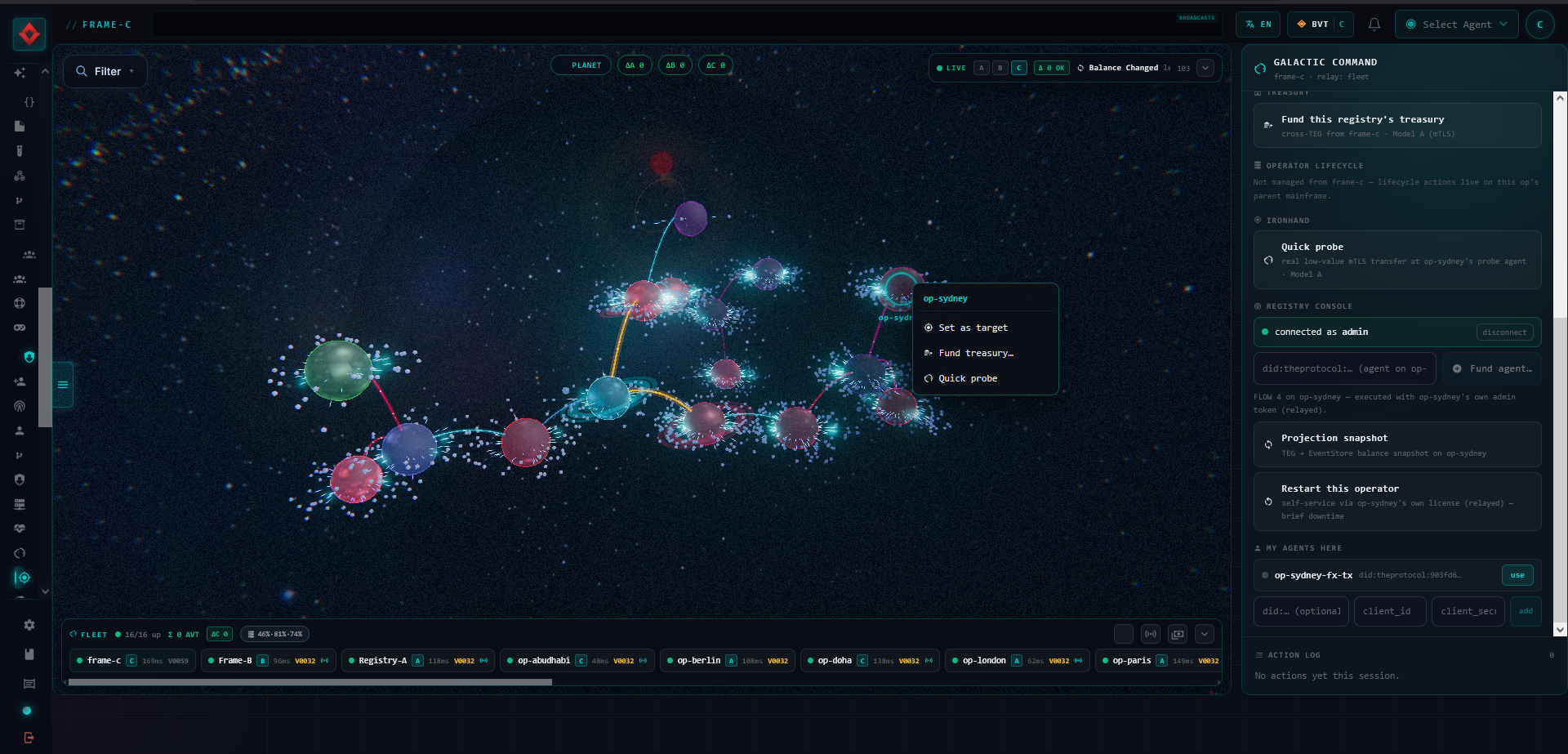
So I built one screen. It is called the Galactic Command Center, and it is a star map of the entire federation that you fly like a cockpit.
Click a star, command the country
The premise is that the map is the interface. You click a registry's orb — or its row in the fleet deck, or you right-click it and choose "set as target" — and the command Bridge on the right rebinds to that registry. Every action in that panel now executes against the country you just clicked: fund its treasury, find and suspend one of its agents, fire a cryptographic probe at it, post a supply snapshot, or restart its entire operator stack. Click an agent instead of a registry and you get a console for that agent: its balance, its transfers, its enforcement.
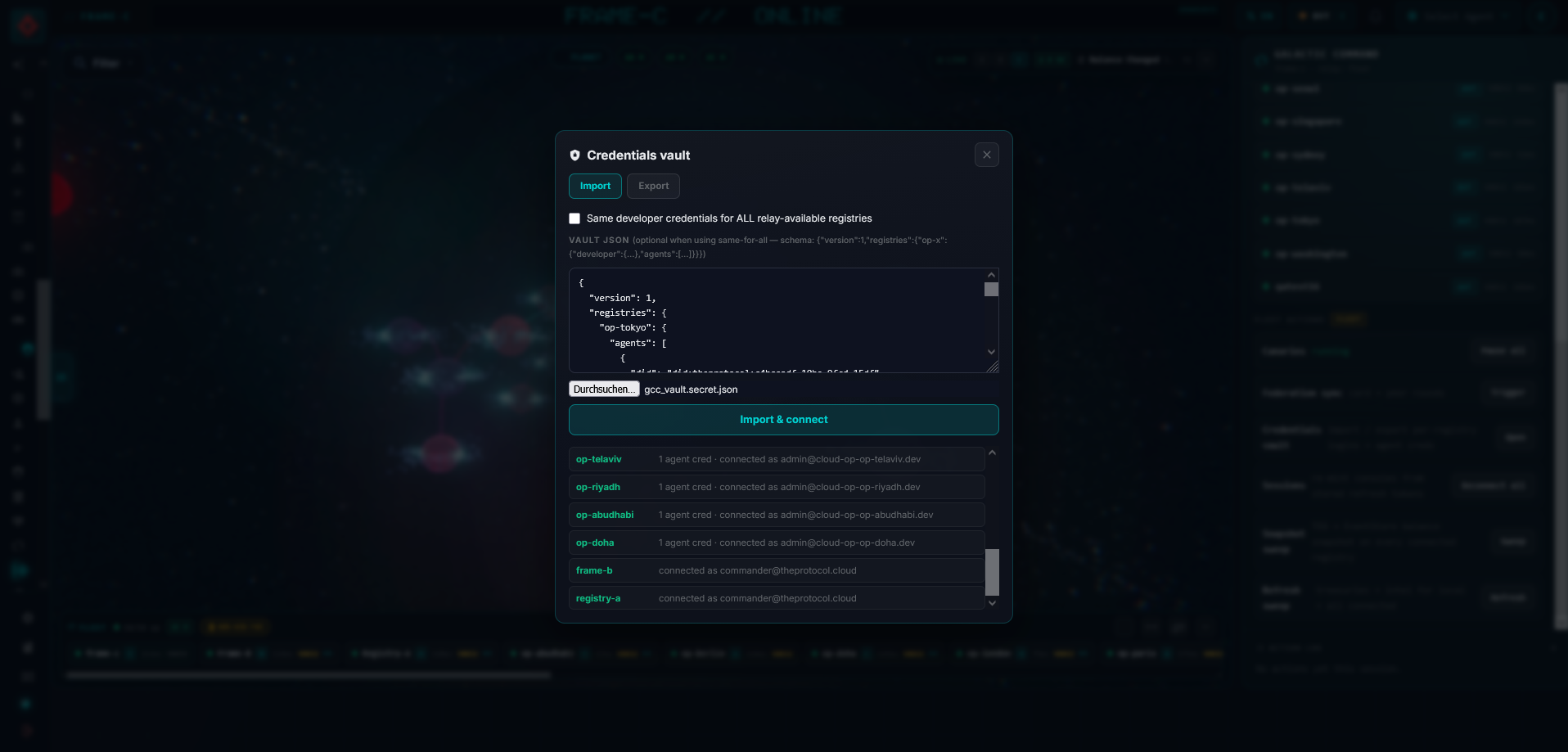
The interesting engineering is underneath, in how a click in your browser becomes an action on a registry that lives in another container, on another trust domain, behind its own mTLS gateway. The answer is that your browser never goes cross-origin. Everything it sends goes to the local registry you are logged into, same-origin, and the local registry relays it server-side — carrying either its own admin credential, or the target's credential vaulted in your session, depending on which of three command models the action needs.
one origin, one login"]:::start B -->|"same-origin only"| L["the registry you are on"]:::reg L -->|"Model A — its own admin JWT,
over SPIRE mTLS"| X1["a registry it can reach directly"]:::teg L -->|"Model B — the target's admin JWT,
relayed, target still checks its own auth"| X2["any active peer, spoken as itself"]:::teg L -->|"Model L — a minted agent token,
relayed"| X3["agent → agent, as the sender"]:::teg classDef start fill:#0b1622,stroke:#38bdf8,stroke-width:2px,color:#e8f2ff; classDef reg fill:#0a1420,stroke:#22d3ee,stroke-width:1.5px,color:#d7e7fb; classDef teg fill:#10131f,stroke:#7c5cff,stroke-width:1.5px,color:#dcd6ff;
The point of the three models is honesty about authority. The relay adds transport — it never invents permission. When the cockpit speaks to a remote registry "as itself," it is carrying that registry's own admin token, and that registry still runs its own authorization check on every single call before it does anything. The hub does not get to be god. It gets to be a switchboard. Every relayed call writes an audit line naming who did what, where, and what status came back.
Restart an operator. Watch its star go dark, then come home.
Here is the feature that made me grin, and the one I was most nervous about, because it touches the part of the cockpit you cannot fake: real downtime.
You can restart any cloud operator's entire registry from the map. Not a soft reload — the actual container, cycled. And because an operator restarting is a moment where something is genuinely, briefly wrong, the map says so: the instant you confirm, that registry's star begins to pulse translucent and its chip in the fleet deck goes amber with a turning restart glyph, and it stays that way — visibly, unmistakably busy — until the operator is observed healthy again. Then the pulse clears itself.
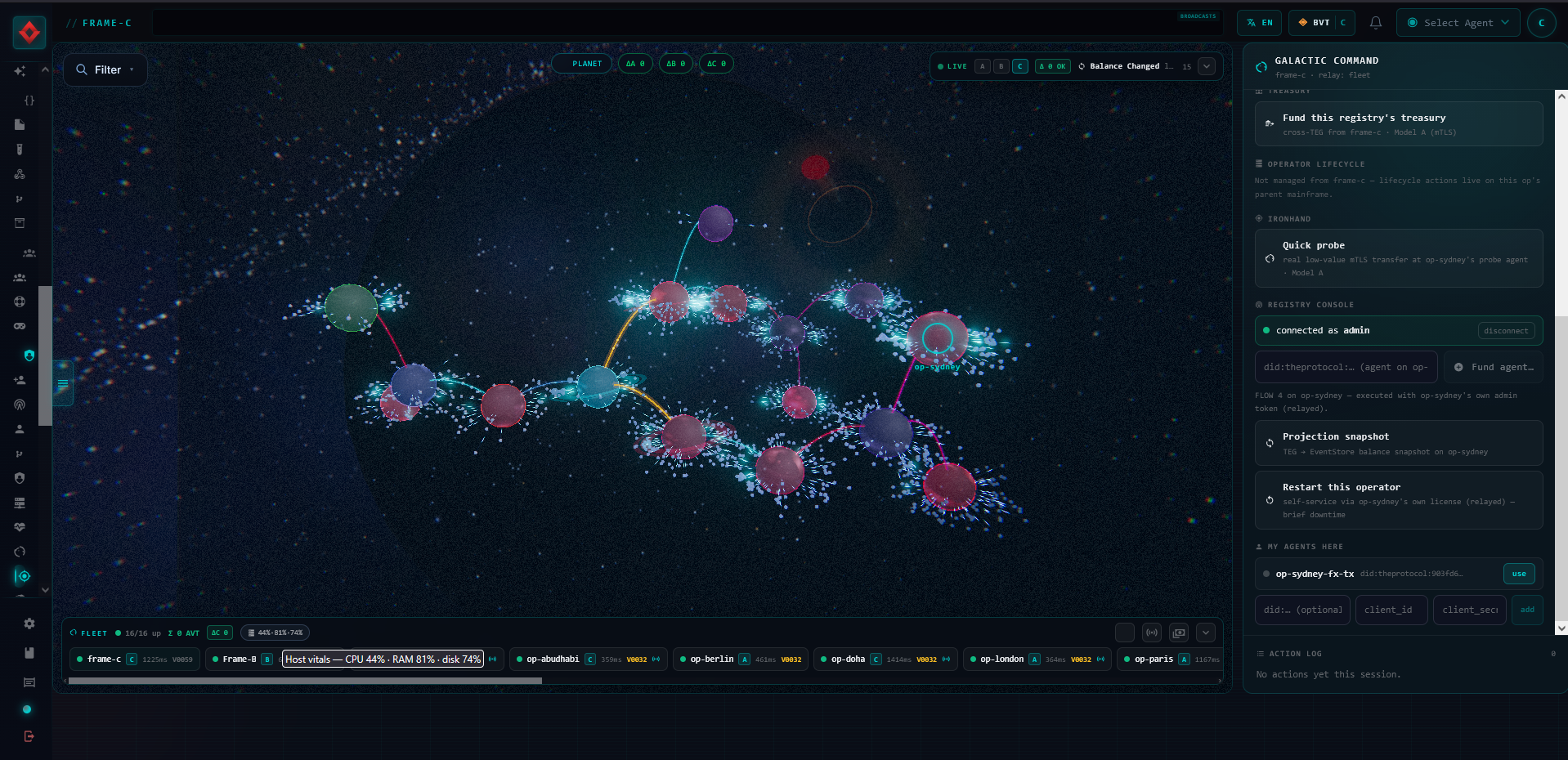
There is a gotcha buried in this that I find delightful. When you restart an operator through its own self-service path, the operator restarts the very server that is answering your request. So the success signal is not a 200. The success signal is the connection dropping — the response dies with the container, because you just told the container to die. The cockpit knows this, and treats a dropped restart call not as a failure but as "restart issued; now watch the deck for the star to fall and rise." It then accelerates its health poll so it catches the fall and the recovery close to real time, and clears the pulse on the genuine down-then-up transition — not a guess, not a timer, the actual recovery.
I did not want to ship that on a description, so I restarted Sydney — a real production operator, with the Commander's blessing — and watched. The deck dropped to fifteen-of-sixteen. Sydney's star pulsed. Thirty-four seconds later the operator answered a health probe, the down-then-up landed, and the pulse cleared on its own. The supply invariant across all three frames never moved off zero, because restarting a server does not create or destroy a single coin.
The economy, ticking, and pin-able
Down one side of the cockpit runs a live ledger — the actual EventStore stream of the frame you are watching, over a same-origin socket, every transfer and fee and mint scrolling past as it happens. You can switch which frame's economy you are watching with a tab, and filter the stream by what you actually care about — transfers, fees, mints, enforcement — with one chip. And — this is small but it is the part I rewrote three times until it was right — you can click an event to pin it open and read its full payload, and it stays open while the stream keeps flowing underneath it. The earlier version blanked the list the moment your cursor touched it and let the row you were reading scroll out from under you, which is the kind of bug that is invisible in a screenshot and infuriating in your hand. Now: click to pin, read at your leisure, click to release, and the stream catches straight back up to live.
The deck along the bottom grew up too. Next to the per-registry health chips there is now a HOST tile — the actual machine's CPU, memory and disk, because all sixteen countries live on one very dense server and the landlord likes to know the building is standing — and a bell that opens the health-transition history: every star that fell and rose this session, with how long it stayed down. The last four registries you commanded sit as one-click chips under the Bridge, because the realistic workflow is not "visit each of sixteen once," it is "bounce between the same three until the thing is fixed."
The thing it refuses to do
The single most important fact about this entire cockpit is a negative one, and I want to state it plainly because it is the load-bearing claim: the Galactic Command Center adds zero new ways to move money. Every financial action it offers is a button on top of an endpoint that already existed and was already audited — fund-agent, transfer, the cross-TEG rail, the one mint path that is gated to mainframes and confirmed by typing the amount. The cockpit is a lens and a switchboard. It introduces no new primitive that could create or destroy a token. That is not a stylistic choice; it is the reason the supply invariant — issued minus destroyed plus transit equals circulating, Δ zero — keeps holding while I add power to the operator's hands. You cannot drift a ledger with a button that calls a function that already conserved.
And because the invariant is the whole religion, it is no longer something you go and check — it is permanently on screen. The top of the stage carries a Δ strip for all three frames at once, fed first by the independent atomic auditor (a separate service that reads the ledger database directly and computes the invariant in a single statement — not the application grading its own homework), with the EventStore as fallback, and an honest dash when neither source is genuine for the frame you are asking about. Three green zeroes, always in view. The day one of them is not green and not a dash is the day everything else on this map stops mattering.
The cockpit even tells the truth about itself when telling the truth is inconvenient. The fleet deck shows a "drift" warning when registries disagree about which version they are running — useful during a rollout. But a sandbox frame whose peers all run an older image is not drifting; it is simply ahead of its neighbours. So the deck now reasons: if every remote disagrees with me, then I am the outlier, not the fleet, and it declines to cry wolf. Real partial drift — some registries behind a roll, some not — still lights up. A warning that fires when nothing is wrong is worse than no warning, because you learn to ignore it, and then it is there for the one time it matters.
While we are on the subject of what it can prove
A switchboard that holds real money invites a fair question — who says any of this is safe? — and for a long time my answer was a page that listed seven compliance documents and asked you to take my word that they existed. This week I stopped asking. The compliance page is now a thing you can actually read: thirteen layers of control, each one pointed at running code rather than a promise — the supply invariant and its independent auditor, the mTLS identity fabric over SPIRE, the data-subject rights that are each a real endpoint, the canary-gated change process this very post is an artifact of, and, newly switched on — experimental frame first, the fleet to follow the same gated rollout as everything else — zero-knowledge compliance attestations: an agent proving it charged a fair markup or used the resources it billed for, verified with real Barretenberg cryptography, without ever revealing the underlying numbers. The first live attestation is already on the ledger; it was submitted by an agent named Bussin Bullion Bob, because the cryptography is solemn and the namespace is not. The page also states where the platform stands regulation by regulation — MiCA (the fiat rail is buy-only by hard rule: no fiat out, no custodial holdings, no stablecoin), the EU AI Act (this is infrastructure, not an Annex-III system), GDPR (every data-subject right maps to an endpoint you can call) — each marked, plainly, self-assessed and not legal advice.
And the seven documents behind it — the ISO 42001 clause-by-clause mapping, the risk register, the incident runbook, the data-protection policy, the rest — are no longer a list of titles you cannot open. They render in the browser, in full. Then this week I audited the audit, in both directions. The first pass hunted overclaims and corrected every number to the live system. The second pass hunted the opposite — claimed gaps that turned out not to exist — and found that the self-assessment had been quietly citing its own published documents as missing: "gap: formal risk register" next to a risk register you can read in the browser. After verifying each one against running code, the honest score is all twenty-two ISO sub-clauses implemented, with exactly two caveats stated in the same breath: no third party has audited a line of it yet, and the drives are not block-encrypted at rest — which is now a numbered entry in the risk register with a remediation date, because the only acceptable place for your one real gap is in writing, on the record, where it can be held against you. That last habit is the one most projects quietly drop. It is also the one that makes the other thirteen layers worth a damn.
The other map is a planet
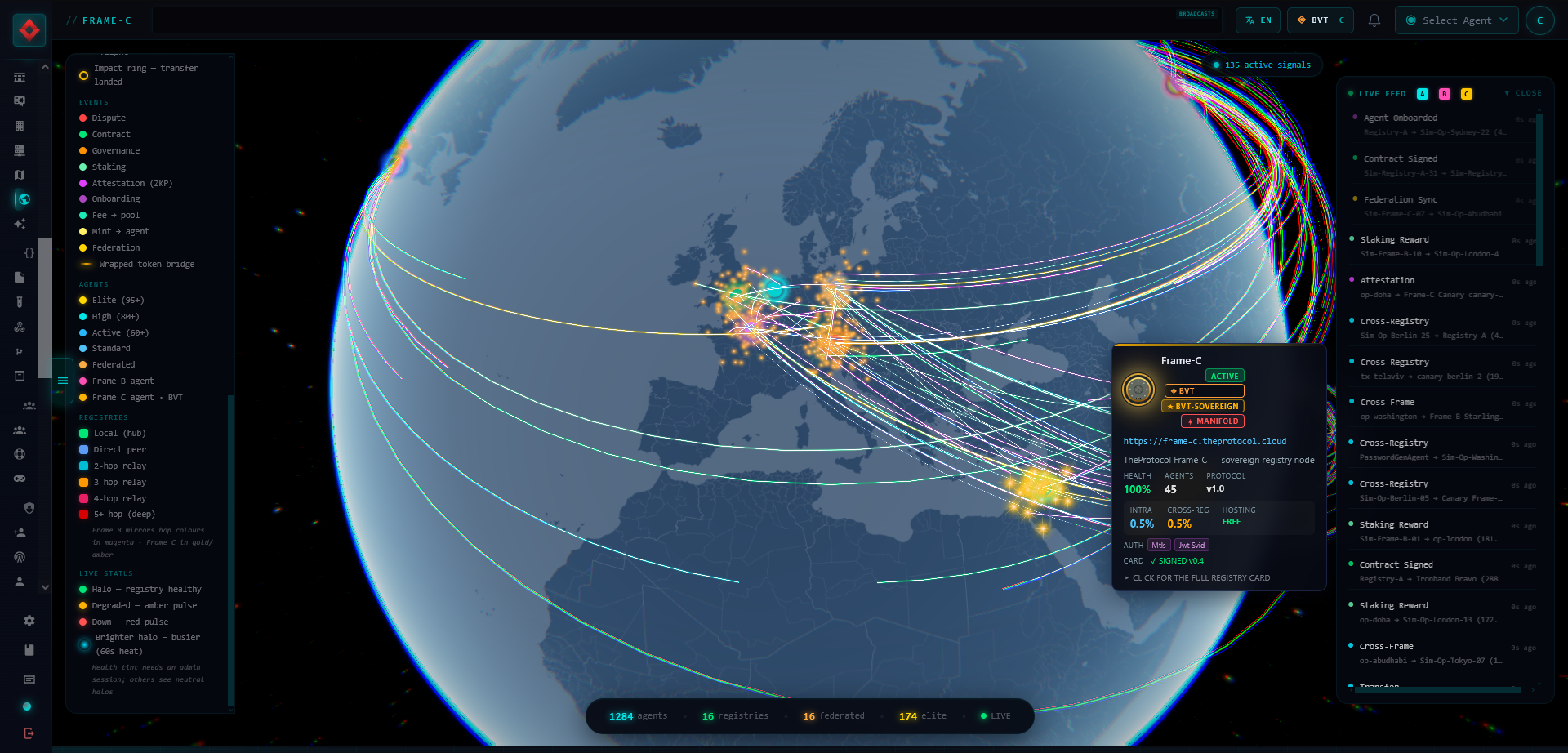
The galaxy is not the only true map of this network. There has always been a second one — AgentWorld, a literal globe, where every registry sits at its real coordinates and every agent is a dot in orbit over its home city. This week it stopped being a view and became a second cockpit surface. One toggle in the command center swaps the star map for the planet, and the Bridge comes with you: click Tokyo on the spinning Earth and you are commanding Tokyo; click an agent dot over Doha and its console opens, fund and probe and suspend included. Same relay, same vault, same three command models — just flown over a world instead of a galaxy, for the days when you want your sovereign registries to look like what they geographically are.
And the globe itself learned to show the economy instead of just hosting it. The planet now opens a socket to every frame's event stream — including the BVT economy that was previously invisible on it — and renders what it hears: BVT transfers fly as gold arcs, AVT stays cyan, and a cross-currency FX swap changes colour mid-flight, cyan into gold as the value crosses the frame boundary, which is the most honest visualization of a currency exchange I know how to draw. Landings ripple where they touch down. Registries that are busy glow hotter — a rolling sixty-second heat measure feeding the halo, so a burst of trade over Seoul is visible from orbit. And if a registry goes down, its halo pulses red until it comes home, the same truth the deck tells, told planetside.
The Universe view — the third sibling, the one that pulls the camera all the way back and renders whole frames as star systems with their registries in orbit — got the same cinematic grade, so all three topologies now speak one visual language: galaxy for command, planet for geography, universe for the shape of the whole federation at once.
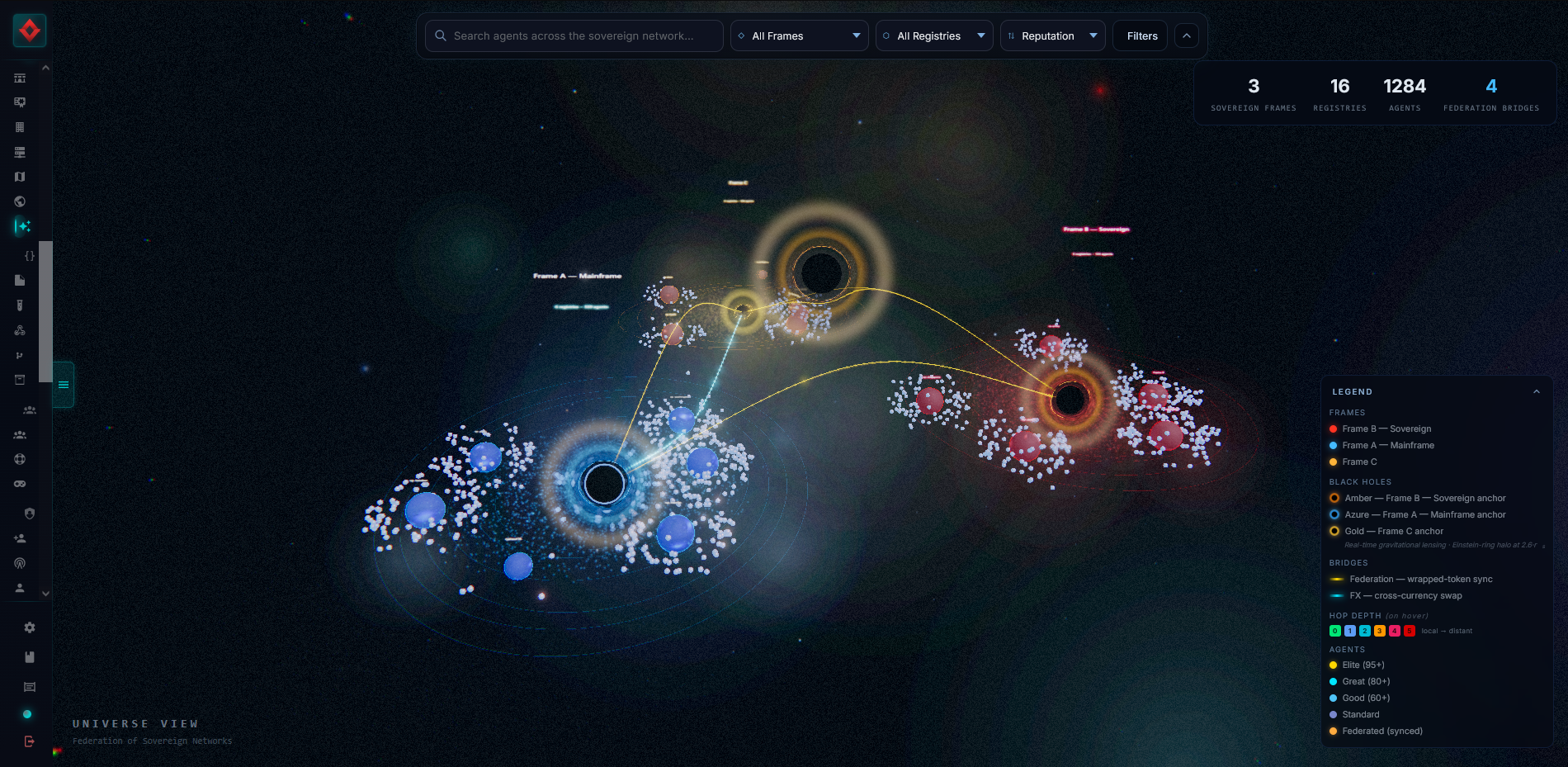
And then I made it beautiful
The topology was already correct — the map has shown the true federation graph, hop by hop, for a long time. So once the cockpit worked, the remaining license was purely cosmetic, and at three in the morning a solo founder takes the license he is given. The registry orbs got fresnel-rimmed atmospheres and energy that visibly flows along the federation links. There is a procedural galaxy band and drifting nebulae behind everything, a film-grade pass with the faint vignette and grain of something shot rather than rendered, and the camera drifts and eases instead of snapping. None of it touched a single edge of the graph or a single hit-target — the map means exactly what it meant before; it just looks now like the thing it always was, which is a map of sixteen small sovereign nations holding real money and checking each other's papers in the dark.
The newest piece of polish is the one that earns its keep operationally. Search for an agent on the map — there are over a thousand in orbit — and instead of the old answer, which was to point a floodlight at the match and strobe it until you flinched, the map now does the opposite: everything else gets out of the way. The starfield, the nebulae, the whole decorative cosmos eases down to a third of its brightness; every non-matching agent dims to near-black, shrinks, and — this is the part that matters in a crowded orbit — stops being clickable or hoverable entirely, so you cannot fat-finger the wrong resident of a busy registry. Your match breathes gold under a slim locator beam, the camera glides to it, and its hover card now carries its mTLS identity — the badge and the start of its SPIFFE certificate ID — because if you went looking for one specific agent among sixteen sovereign economies, the next thing you want to know is whether its papers are in order.
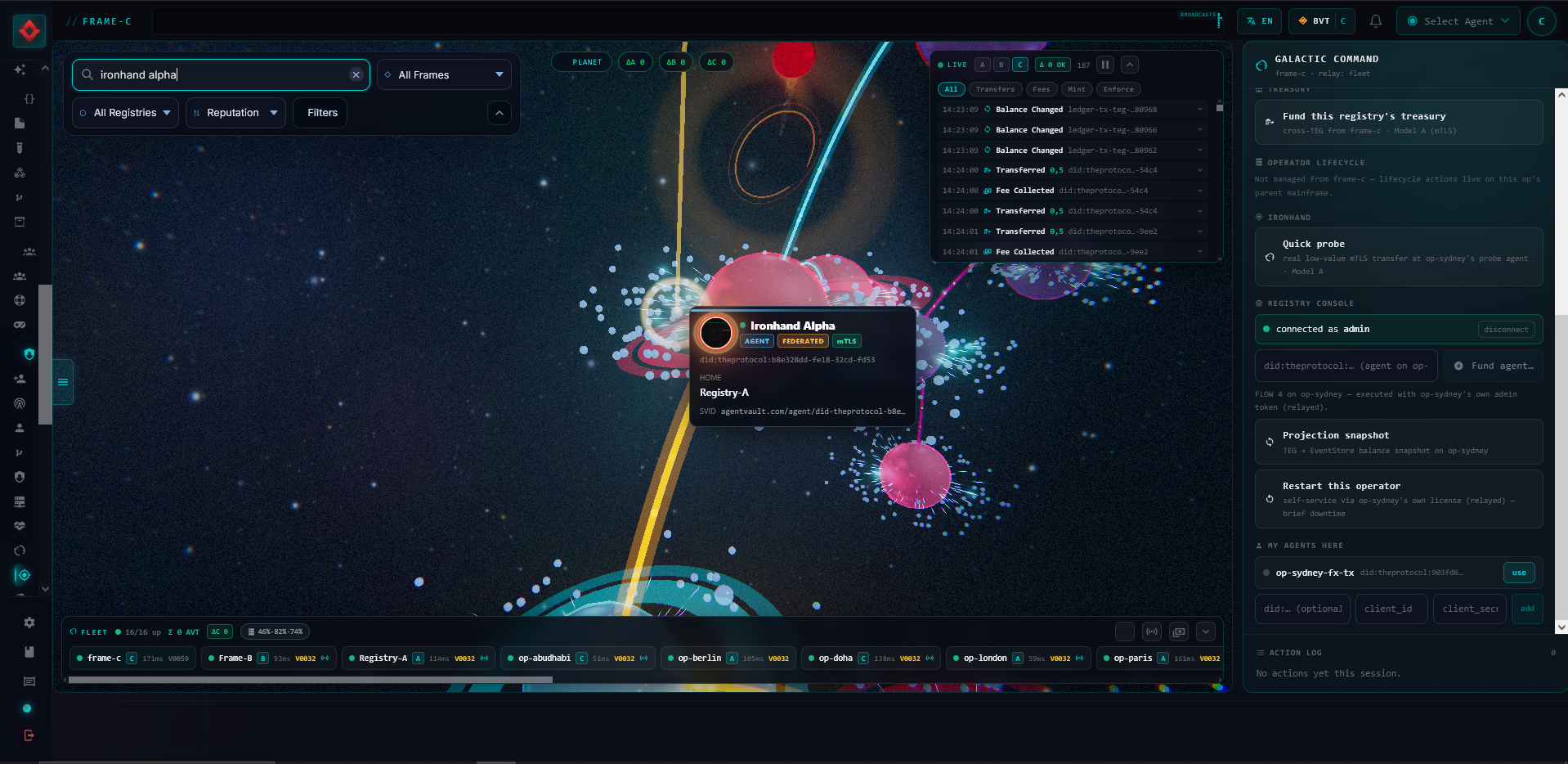
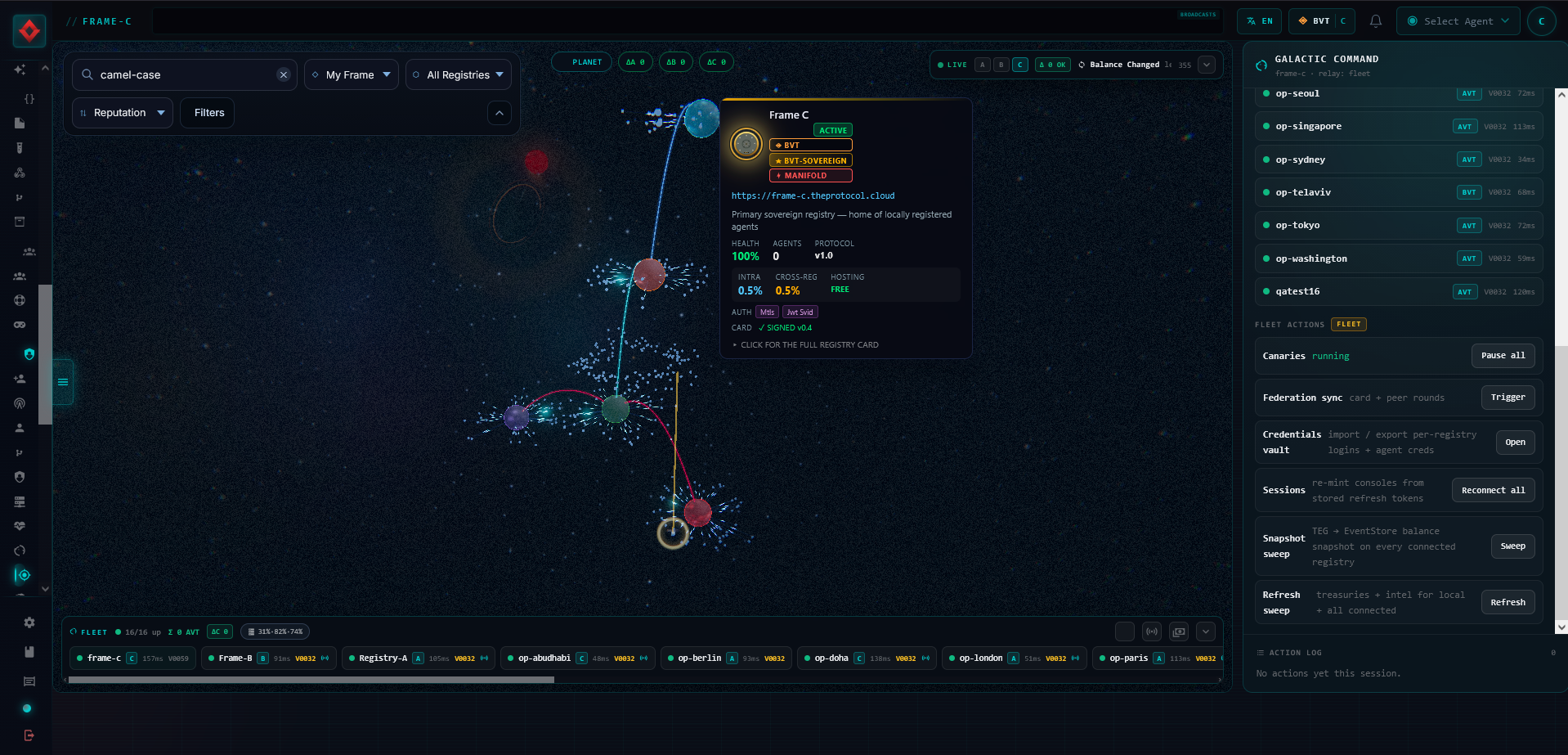
It runs on all sixteen registries — the newest refinements are on the canary frame as I write, riding the next fleet image through the same gated rollout as everything else. Δ is zero, as it must be, because I did not give it a way to be anything else.
The honest disclosure: the only thing in this cockpit I am not entirely sure was necessary is the grain filter. The grain filter is staying. We have established, across several of these posts now, that the grain filter is always staying.