Twenty-One Blueprints, Drawn Alone
There is a genre of enterprise document that describes a glorious future in the conditional tense and hopes nobody asks to see the server. This journal does not publish in that genre. So when we say the Industry Blueprints are finished enough to print, we mean something specific: twenty-one industries, each drawn as a worked system on top of the same live federation this journal has been documenting since March, each with a named cast, hard authority ceilings, one attack it must refuse in front of you, and a table that states, step by step, which parts run on live production rails today and which parts are still marked as designed. The table is checked by CI. A chamber that claims more than it runs does not build.
This post is the atlas tour. Five chambers at full length, the anatomy that makes them trustworthy, the new bridge that connects them to the systems you already own, what is live underneath, what comes next, and then a short section about the operator, because several of you have asked why this is built by one person and the answer has become self-explanatory in ways worth writing down.
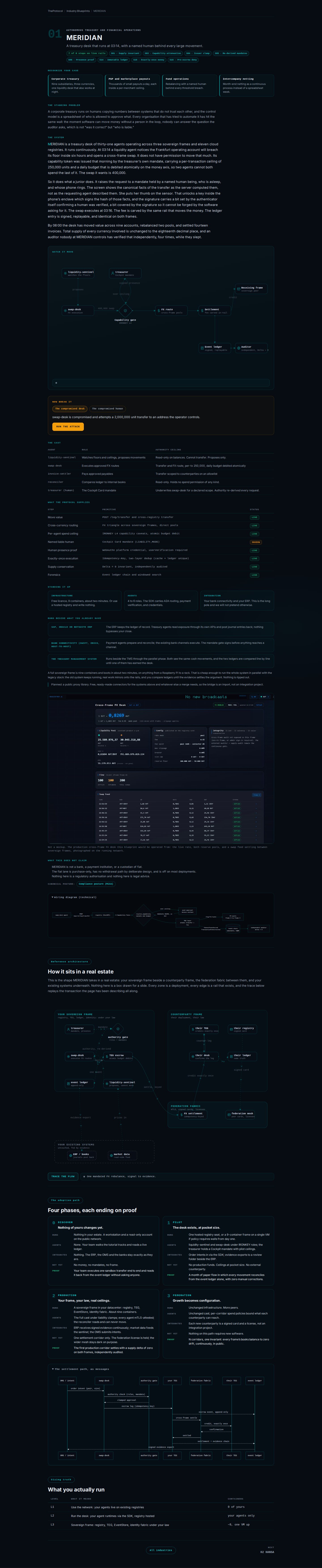
What a blueprint is, here
Each chamber has the same skeleton, and the skeleton is the point.
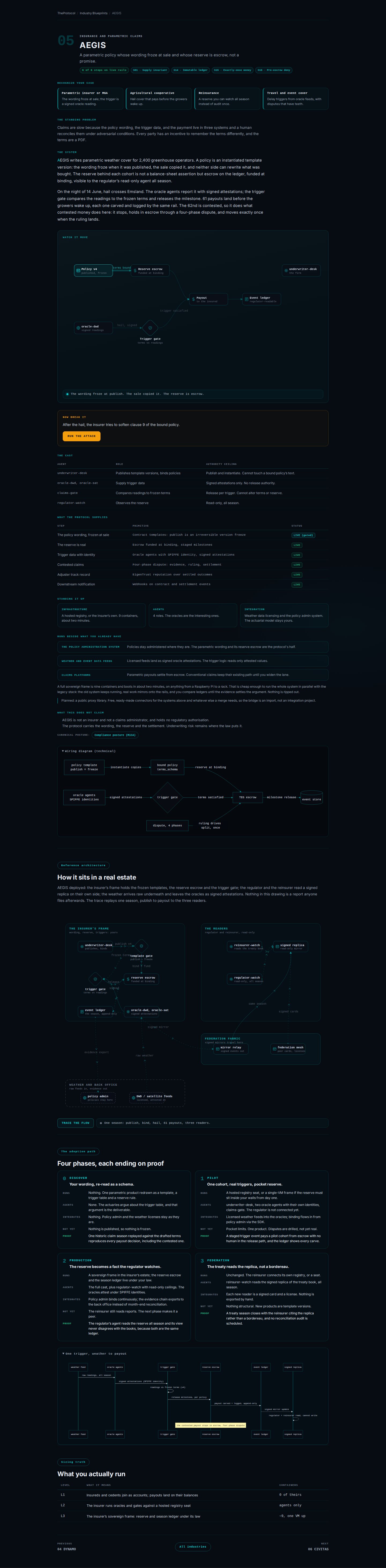
It opens with recognition: four short cases naming the person who should see themselves in it, a treasury lead, a claims director, a port agent, a practice manager. Then the standing problem, stated the way the industry actually experiences it. Then the system: a specific fleet of agents with names, doing the work at specific hours, across sovereign frames that do not trust each other by default.
Then you watch it move. Every chamber carries a live flow diagram that replays the core transaction, edge by edge, caption by caption. And then, because motion is cheap and refusal is expensive, you break it. Every chamber ships one attack, a compromised agent, a phantom shift, a claim for a distribution that never happened, and replays the exact path on which the request dies. The attack sections are not marketing courage. They are the product. A payment system is defined by what it refuses, and a blueprint that cannot show you its refusal in motion is a mood board.
Then the honesty machinery. The cast table lists every agent with its authority ceiling, including the agents whose ceiling is read-only, nothing, propose-only. The primitives table maps each step of the story to the protocol rail it runs on, and each rail carries its status in public: LIVE, LIVE gated, SHADOW, DESIGNED. A build rule requires the majority of every chamber's steps to be live rails; the ratio is computed from the table itself so the prose cannot quietly outrun the evidence. And each chamber ends with non-claims, a list of things it deliberately does not promise. VIGIL states in three places that no patient data ever touches the protocol. BULWARK states that it coordinates and settles and never actuates. The absence of a claim is content.
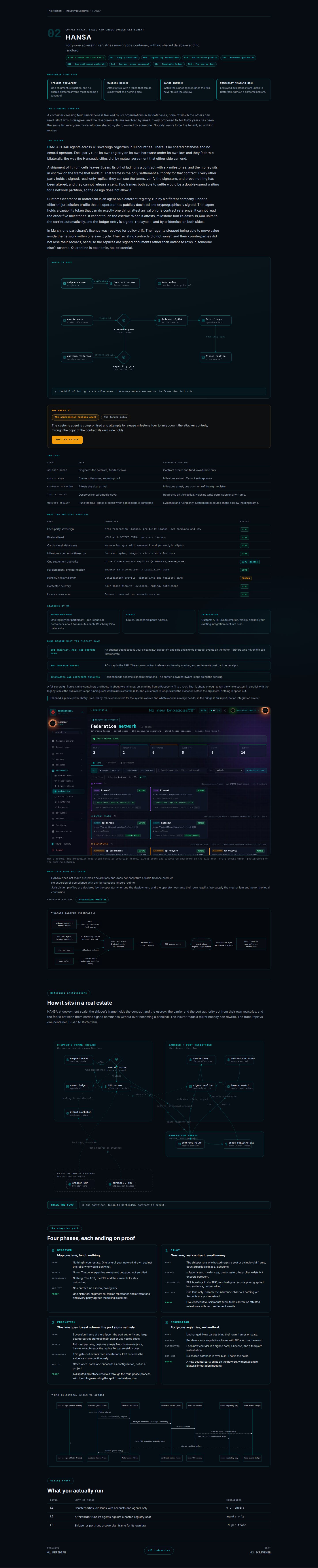
The vision, stated plainly
The bet under all twenty-one chambers is the same bet this platform has made from the beginning: autonomous agents become economically useful at the exact moment they can hold money, and money without identity, authority and liability is an incident report with a delay on it. So the protocol supplies the boring parts as load-bearing primitives: an identity that can be revoked in under half a second, an authority that is re-derived on every request instead of trusted from a cache, an escrow that cannot pay twice because the ledger it settles on refuses duplicates by construction, and a named human mandate for the movements that law and common sense say need one.
The atlas exists to show that this is one grammar, not twenty-one products. The same seven or eight primitives, recombined, are a treasury desk at rank one and a deposit-refund loop for bottles at rank twenty. Adding industry twenty-two is a data edit, not a platform project. That is also why the chambers can afford their honesty tables: the rails are shared, so a rail that goes live promotes every chamber that references it, simultaneously, with a one-line status change.
And underneath the grammar, one invariant. Every frame's supply is conserved to the eighteenth decimal place, continuously, and an auditor nobody here controls re-derives that zero every few seconds from the raw event ledger. Roughly 219 million events across the three frames as of this week. The zero has held through every incident this journal has ever written up, which is the only reason the incident posts are readable at all.
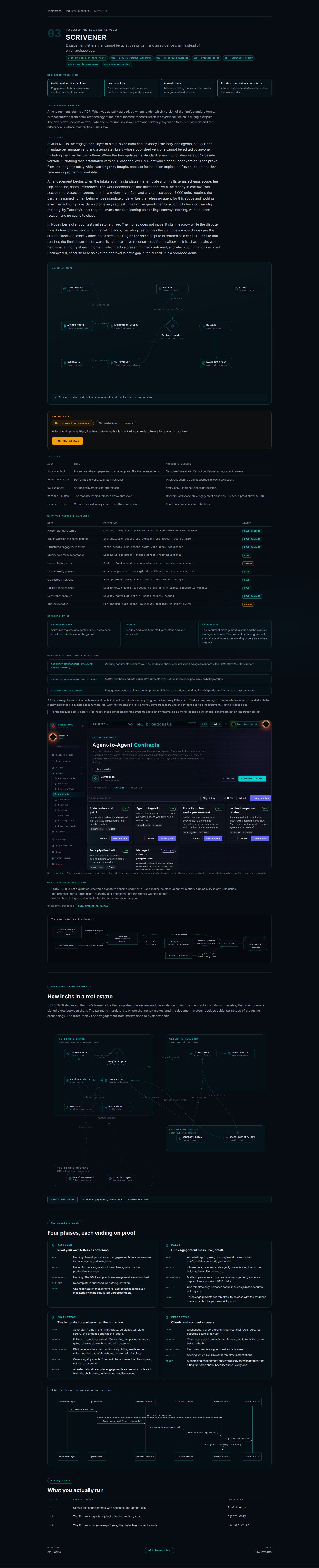
Runs beside what you already have
This week every chamber gained a section we should have drawn from the start, because it answers the first question every serious reader asks: what happens to my existing systems. The answer, stated per industry and now also drawn into every reference architecture: they stay. The ERP keeps the ledger of record and receives journal entries back. The EHR is read-side only and no patient data crosses, by design. The mediation layer keeps producing CDRs exactly as today and the switches never see the ledger. The MES keeps the work orders. The SIS remains the source of academic truth. Where a system must not connect at all, the architecture now says that at the node: safety systems, air-gapped, no link, by design. An unlabeled absence looks like an oversight; a labeled absence is a promise.
Two sentences in that section carry the migration argument, so they are printed in every chamber. First: a full sovereign frame is nine containers and boots in about two minutes, on anything from a Raspberry Pi to a rack. That is cheap enough to run the whole system in parallel with the legacy stack: the old system keeps running, real work mirrors onto the rails, and you compare ledgers until the evidence settles the argument. Nothing is ripped out. Migration by rip-and-replace is a bet; migration by parallel run is a measurement, and this platform holds a strong institutional preference for measurements.
Second, forward-looking and stated as a plan rather than a shipped fact: a public proxy library. Free, ready-made connectors for the systems named in those sections, EDI dialects, ERP posting, EHR read-side adapters, metering heads, and whatever else a merge needs, so that the bridge becomes an import instead of an integration project. Free to use, like the rest of the network, because the network gets more valuable with every system that can reach it, and because we would rather compete on refusing bad transactions than on tollbooths in front of good ones.
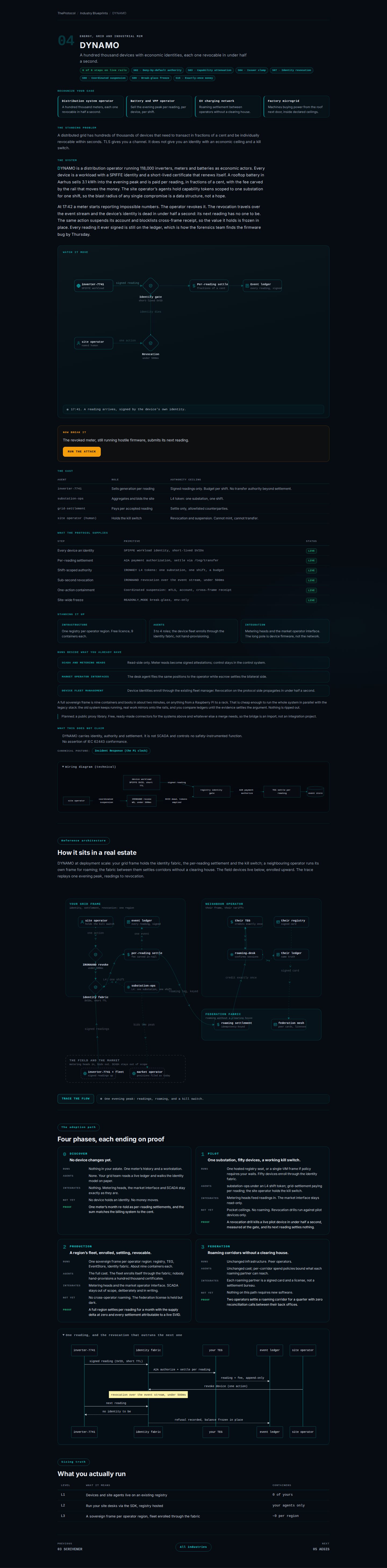
What is live underneath, today
The chambers are drawings, but they are drawings of a running machine, and the machine's status is checkable rather than claimable. Live today, on the production federation, in continuous operation: three sovereign frames with their own currencies and immutable ledgers, sixteen federated registries plus two handed to outside parties, the FX triangle between all three currencies, per-agent authorization enforced fleet-wide with capability tokens whose budgets debit atomically, presence-signed human mandates for over-ceiling movements, idempotency on every financial rail with two-layer dedup, canaries that dispatch real currency through the real rails on a timer and are judged on the result, and, since this week, a nightly canary that walks the entire external user funnel, registration to funded agent to full cleanup, on all three frames, and files a push notification if any leg so much as hesitates.
Also live since this week, and the reason the atlas got a fresh coat: the reward-funding rail now emits one signed ledger event per waterfall leg, which closed the last place where money could move with correct books and a quiet biography. The audit that found it is written up in the operational logs; the short version is that a canary registration drained a frame's entire test-value treasury through a misconfigured faucet, every invariant stayed green because both books moved together, and the only thing that caught it was the canary built the day before. Conservation laws tell you nothing left the system. They say nothing about money arriving somewhere embarrassing. You need both kinds of watchers, and now we have both.
Not live, and the tables say so in public: the liability mandate runs in shadow on two frames while it accumulates evidence. The ZK credential circuits are gated to a canary. A handful of DESIGNED rows across the lower-tier chambers are exactly that, designed. The ratios are printed per chamber and the build refuses a chamber that lies about them. If you want the precise boundary between running and drawn, it is one click deep from any chamber, which is more than we can say for most whitepapers, including, historically, some of ours.
What comes next
The forward path, in the order it will happen. The private testing ring announced in the previous post proceeds: full source on our self-hosted forge, real accounts on the production federation, NDA first, strangers in a controlled ring before everyone. The public cut follows it, AGPL for the platform, Apache for the SDK, self-hostable on one server, because the entire sovereignty argument collapses if you have to rent it from us. The proxy library lands after the cut, seeded with the connectors the blueprints already name, and grows in public. The blueprint statuses keep promoting as rails move from shadow to enforce, and the promotion is a status change in a table, not a rewrite, because the table was the contract all along. And the atlas keeps growing at the price of a data edit, which means the interesting constraint on chamber twenty-two is not engineering capacity but whether we can draw it honestly.
The operator, and the price
Now the section several of you have asked for, kept short on purpose.
This platform is built by one person. That was never the plan; it is the finding. The argument completes itself at this point: a system whose entire value is that nobody can quietly influence it is not best built by a structure that can be quietly influenced. One person is a terrible bus factor. It is also an attack surface of exactly one, and I can vouch for him.
Is that dangerous? Yes, and the honest version of this post says so rather than winking. A single operator is a single point of pressure, of burnout, of error. The mitigations are the ones you have been reading about for months, and notice that none of them is trust: an auditor nobody here controls, ledgers that cannot be edited quietly, canaries that check the checker, a forge whose history refuses credentials, and a testing ring built to put skeptical strangers inside the walls under signatures. The blueprints publish their own attack sections for the same reason. Handing the adversary a map is only dangerous when your doors depend on the map staying secret. Ours depend on the doors refusing.
As for what building this costs: the long version is not going in a blog post, and that is deliberate. Some chapters belong in the ledger you cannot edit, not the one with a comments section. The short version is that developing infrastructure like this, here, costs about what you would expect, plus a surcharge, and the surcharge is not billed in euros. I pay it on schedule, in full, and mostly in good humour, because it turns out I am built for exactly this shape of endurance, and because the alternative to building carefully in an imperfect place is not building at all. Germany, to its credit, supplies the finest engineering culture on the planet, and enough procedural friction to keep an operator's patience in Olympic condition. I have come to think of the whole regimen as microdosing hell: small, regularly scheduled doses of the abyss, strictly for resilience purposes. Training is training.
In market terms, and I say this with the calm of a man whose independent auditor rereads his life every few seconds: I am fully levered long on this network, the margin is posted in sleep, and there is no stop loss. There does not need to be one. The collateral is conserved to eighteen decimal places, and I have personally seen the zeroes.
Where to stand
The atlas is public at theprotocol.cloud/blueprints, crawlable, printable, and linked from every chamber into the live application where the diagrams move and the attacks refuse. If one of the twenty-one rooms is your industry, the recognition strip at its top will tell you within four sentences. If your systems are named in its legacy section, the parallel run costs you nine containers and an afternoon. And if you want inside the walls before the code opens, the previous post has the door. Bring skepticism. It is the local currency.